 4 min read
 Setting Rules for Toddlers: A Calm Discipline Approach That Builds Responsibility
If you’ve ever searched “how to discipline a toddler without yelling” or “positive discipline strategies for 2-5 year olds,” you’re not alone. Parents across the United States are actively looking for ways to guide their children without constant power struggles. Toddlers test limits. They repeat behaviors. They ignore instructions. They melt down in grocery store aisles. And in those moments, even the calmest parent feels their patience slipping.

If you’ve ever searched “how to discipline a toddler without yelling” or “positive discipline strategies for 2-5 year olds,” you’re not alone. Parents across the United States are actively looking for ways to guide their children without constant power struggles. Toddlers test limits. They repeat behaviors. They ignore instructions. They melt down in grocery store aisles. And in those moments, even the calmest parent feels their patience slipping.
But here’s what research tells us: yelling may stop behavior temporarily, but it does not teach self-control. According to the American Academy of Pediatrics (AAP), harsh discipline strategies are linked to increased aggression and emotional reactivity in children. In contrast, consistent and calm guidance supports healthier emotional development.
So what actually works?
The answer lies in positive discipline - a balanced approach that combines clear rules with guided choices. But here’s the important truth: yelling might stop behavior temporarily, but it doesn’t teach long-term self-control. What toddlers need isn’t louder discipline. They need clearer guidance.
Why Yelling Doesn’t Teach Self-Control
Between ages 2 and 5, a child’s brain is still developing executive function, the skills responsible for impulse control and emotional regulation. According to the Harvard Center on the Developing Child, these skills are built gradually through consistent guidance and supportive relationships.
When we yell, behavior might stop temporarily. But fear does not build self-regulation. Research published by the American Academy of Pediatrics shows that harsh verbal discipline is linked to increased aggression and behavioral challenges over time.
Calm, predictable discipline builds internal self-control instead of fear-based compliance. And this is exactly the message children need to understand early: rules are not punishment - they are guidance.
Why Setting Rules for Toddlers Actually Helps
Many parents worry that rules might limit creativity or independence. Research suggests the opposite. The CDC notes that children thrive in environments with consistent routines and clear expectations because predictability reduces stress.
When toddlers know what to expect:
- They feel safer
- They cooperate more easily
- They experience fewer emotional outbursts
Rules don’t restrict children. They stabilize their world.
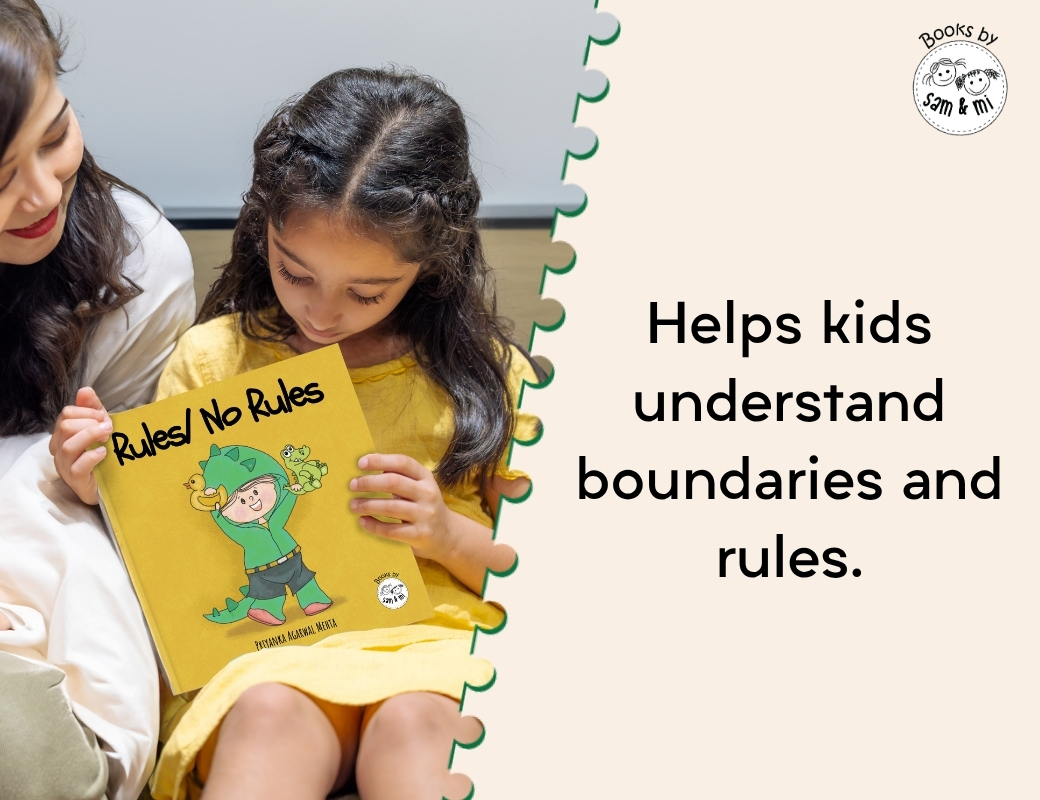
This balance between stability and independence is at the heart of the picture book Rules/No Rules by Sam & Mi, which gently shows children what happens when there are no boundaries and why simple structure actually makes daily life smoother and more enjoyable. Instead of labeling rules as “strict,” the book reframes them as tools that create fairness and shared responsibility.
The Balance Between Rules and Choice
Positive discipline is not about removing boundaries. It’s about combining structure with empowerment.
For example: “I won’t let you throw toys. Toys are for building. If you throw it again, we’ll put them away.” The boundary is firm. The tone is calm.
Then offer a choice: “Would you like to build a tower or a bridge?”
This balance strengthens:
- Decision-making skills
- Emotional regulation
- Responsibility
- Confidence
Children learn that they have freedom, but within limits.
This concept, structure, & choice is beautifully modeled in the Rules/No Rules book. Through relatable scenarios, children see how chaos feels confusing, while balanced rules create predictability and comfort. It becomes easier for parents to say, “Remember what happened in the story?” instead of repeating commands.
That shift changes discipline from confrontation to conversation.
Tantrums Are Normal - Guidance Is Essential
Tantrums are one of the most searched parenting concerns in the United States. Studies published in Pediatrics confirm that tantrums are common between ages 1-4 due to immature emotional regulation and limited communication skills.
The solution isn’t louder correction.
It’s:
- Stay calm
- Name the emotion
- Restate the rule
- Offer a structured choice
Over time, this consistent approach builds internal discipline, not external fear. Rules/No Rules visually uses these approaches & makes this process easier. When children see characters navigating rules and consequences in a safe, engaging format, they internalize those lessons naturally.
Why Early Responsibility Matters
According to CASEL (Collaborative for Academic, Social, and Emotional Learning), early social-emotional skills are directly connected to long-term academic and life success.
When toddlers learn:
- To respect boundaries
- To make thoughtful choices
- To manage emotions
- To take responsibility
They build a foundation for lifelong confidence.
Rules/No Rules supports these exact skills - responsibility, ownership, creative thinking within structure, emotional management - in a way that feels playful rather than preachy. It helps children see that following rules doesn’t remove fun, it actually makes fun possible.
Final Thoughts: Discipline That Builds Confidence
If you’re trying to discipline your toddler without yelling, always remember:
- Rules create security.
- Choices build independence.
- Consistency builds confidence.
And sometimes, the most effective parenting tools aren’t louder voices, they’re meaningful conversations.
If you’re looking for a gentle, story-driven way to reinforce positive discipline at home, you can learn more about our book:
Buy Now: Rules/No Rules (Now on Amazon)
Because discipline isn’t about control, it’s about helping your child grow into a confident and considerate individual.
Frequently Asked Questions
1. Is Rules/No Rules good for teaching responsibility to toddlers?
Yes, it helps children understand responsibility by showing how simple rules create fairness and balance in everyday life.
2. Can this book help with toddler discipline without yelling?
Yes, it supports positive discipline by helping kids visually understand boundaries, making calm conversations easier for parents.
3. Is Rules/No Rules suitable for 2-5 year olds?
Yes, the book is designed specifically for toddlers and preschoolers with simple language and engaging illustrations.
4. Does this book help reduce toddler tantrums?
Yes, it encourages emotional awareness and structured choices, which can reduce power struggles over time.
5. Is Rules/No Rules based on positive parenting principles?
Yes, it promotes balance between rules and independence, aligning with modern positive discipline strategies.
6. Can parents use this book as a discipline tool at home?
Yes, many parents use it to start conversations about boundaries and responsibility in a non-confrontational way.
7. Where can I buy Rules/No Rules by Sam & Mi?
The book is available on Amazon: 👉 Buy Now
Sam and Mi
At Sam and Mi, we write children’s books for the age group of 0-8 years. Our books focus on themes of empathy, problem solving and communication. When introduced to children at an early age, we believe these skills can contribute to leading a happy and successful life. Our books are not only warm, sensitive and fun but also based on research and trials with children. The stories are built through playful text and supported by beautiful illustrations to attract children to the wonderful world of books. Every product we offer is a true collaboration between a child and a mother. We hope you enjoy your journey with us and encourage you to share your child’s experiences with our products!