 3 min read
 The magic formula for raising a reader
I love the concept of 10,000 steps a day to stay fit. It is simple,...

I love the concept of 10,000 steps a day to stay fit. It is simple, measurable and can be universally applied (for the majority). If I am checked into a hotel, and I see a woman or a man in a business suit pacing up and down the corridor post dinner and a rubber strap on their hand, I know for sure that they are trying to finish their 10,000 steps for the day. Reading in early childhood should be the same way. For far too long we have complicated reading by constantly attaching it to academic success. What if I told you that reading can be developed as a love language which when shared between a parent and a child in early childhood, becomes your child’s way of life in adulthood. This love language will not only make it easy to spend time together as a family for eternity but also allow for seamless communication and understanding, laying the foundation of a strong parent-child relationship.
Today I am going to share with you the magic formula for raising a reader in as simple, measurable and universal way (for the majority) as 10,000 steps.
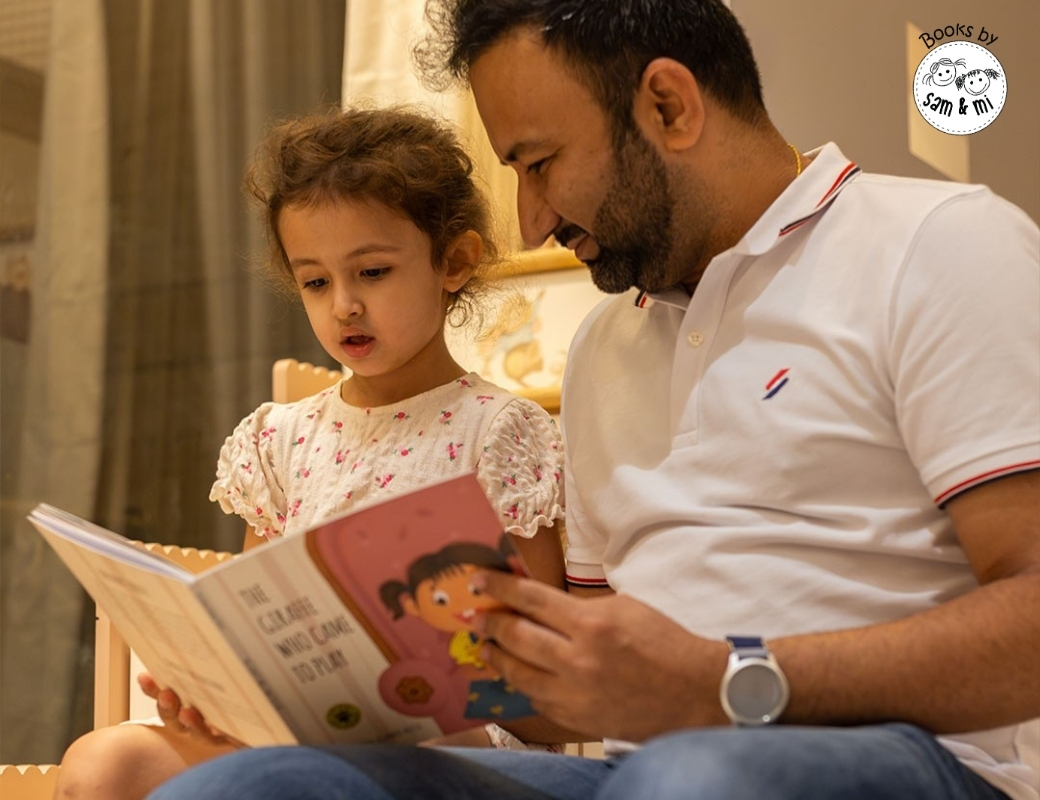
Ready? Read 5 books a day with your child when they are between the ages of 0-6 years old. 10,000 steps for your future. 5 books a day for your child’s.
FIVE BOOKS! What was your first reaction? Omg do I really have that kind of time?
Five books of 100 words each between the ages of 0-2 should take you, well, FIVE MINUTES.
Does that still sound like a lot?
Five books of 500-750 words each between the ages of 2.5-6 would probably take you 20-30 minutes.
Now that might sound like a lot? I understand. It’s not that you don’t want to spend those thirty minutes reading to your child, it is just that you don’t have the time. Tell me about it! So how do we do this?
Each book of 500-750 words will take you around 5-6 minutes each to read. How about if we do this through the day instead of in one-go:
- 2 books (10 minutes) at breakfast
- 1 book (5 minutes) post school
- 1 book (5 minutes) before bathtime
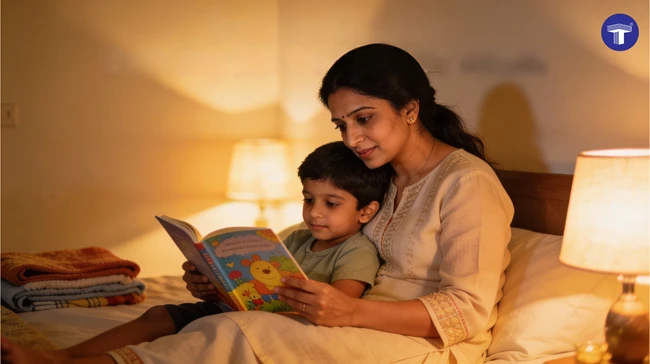
- 1 books (5 minutes) at bedtime
Want me to make it even easier? I would be thrilled to do that:
- It doesn’t all have to be in the same language or by the same person. For instance, both parents can read two books each, a grandparent/ caretaker/ day care can read the fifth one in the language of their choice! You can modify this as per your family structure.
- You can also pick a few shorter books and a few longer ones. This would bring down the time required each day. My husband reads to the children at bedtime and if he is really tired, I promise to you that he tends to pick books that he knows will only take a minute or two to read.
- I would also HIGHLY encourage you to keep repeating the same books for extended periods of time. There are some books that I have been reading to my kids for years on repeat (Grandma Mottainai, Adventures of Samara and Alphabet, Time Life Encyclopedias ).
What should your goal be while reading 5 books a day?
- To bond with your child.
Yes, that is it. I don’t want you to worry about making her/ him read. Learning will be a by product of loving. I want you to worry about using reading as a tool to connect with your child, talk to them about your experiences and values and listen to them about their thoughts, inhibitions and experiences. I want you to use reading as a language of love.
What happens if I can't read 5 books a day?
The same thing that happens if you can’t walk 10,000 steps a day. You manage but the next day, you do try again to get to 10,000 steps. What if your health doesn’t permit 10,000 steps? You slowly build your stamina to get to 10,000 steps. The same way depending on where you are in your reading journey with your child, the goal will be to build to and to keep reading 5 books a day.
I know one thing about most parents: They want exponentially more for their child than they had for themselves. Even if a parent is not a reader, they want to raise one. So if you would do anything to finish those 10,000 steps for your fitness, then wouldn’t you do just about anything for your child’s future too?
Hands up, if you’re going to try the 5 books a day challenge! In the meantime, I am going to go figure out how to make a fitbit for this (we will call it a Ms ReadALot?).
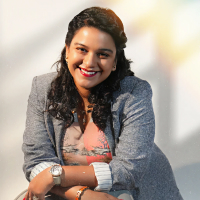
Source: Priyanka is a mother, author and the founder of Sam and Mi, a publishing house for children's books.

Sam and Mi
At Sam and Mi, we write children’s books for the age group of 0-8 years. Our books focus on themes of empathy, problem solving and communication. When introduced to children at an early age, we believe these skills can contribute to leading a happy and successful life. Our books are not only warm, sensitive and fun but also based on research and trials with children. The stories are built through playful text and supported by beautiful illustrations to attract children to the wonderful world of books. Every product we offer is a true collaboration between a child and a mother. We hope you enjoy your journey with us and encourage you to share your child’s experiences with our products!