 3 min read
 Creative Thinking - It’s Child’s Play!
Creative thinking is among the most essential skills of the future. It allows us to empathise, understand the heart of the problem, and iterate solutions until we find one that works. Children use this skill all the time - when they pick up a new skill, navigate new social scenarios, or solve problems at school. They also use this skill (very deftly!) when they negotiate with us.

Hello everyone!
A few months ago, I walked into my older daughter's room and realised that she had taken apart her magna tiles and sandwiched slime, playdough and pencil shavings in a few of them.
“What are you doing, Samara?” I asked her. One part of me was thinking of their now shortened life-span. Thankfully my more dominant part was intrigued about what my 7-year-old was concocting!
"Mom, I want to build a pool with the magna tiles, but the water keeps seeping through. So I am trying to figure out what I can use instead."
"Did anything work?"
"No! None of these have worked."
But it was clear from her determined face that she hadn't given up. We have always encouraged her to think of creative solutions, but what amazes me every time is how she applies this skill.
Creative thinking is among the most essential skills of the future. It allows us to empathise, understand the heart of the problem, and iterate solutions until we find one that works. Children use this skill all the time - when they pick up a new skill, navigate new social scenarios, or solve problems at school. They also use this skill (very deftly!) when they negotiate with us.
Additionally, creative thinking helps children take responsibility for their tasks. For instance, if my daughter resists finishing her writing assignment, we ask her to tell us why and suggest some solutions. The most likely scenario is that she will complete the work after doing some hand stretches or, after a five-minute break, or while listening to music.
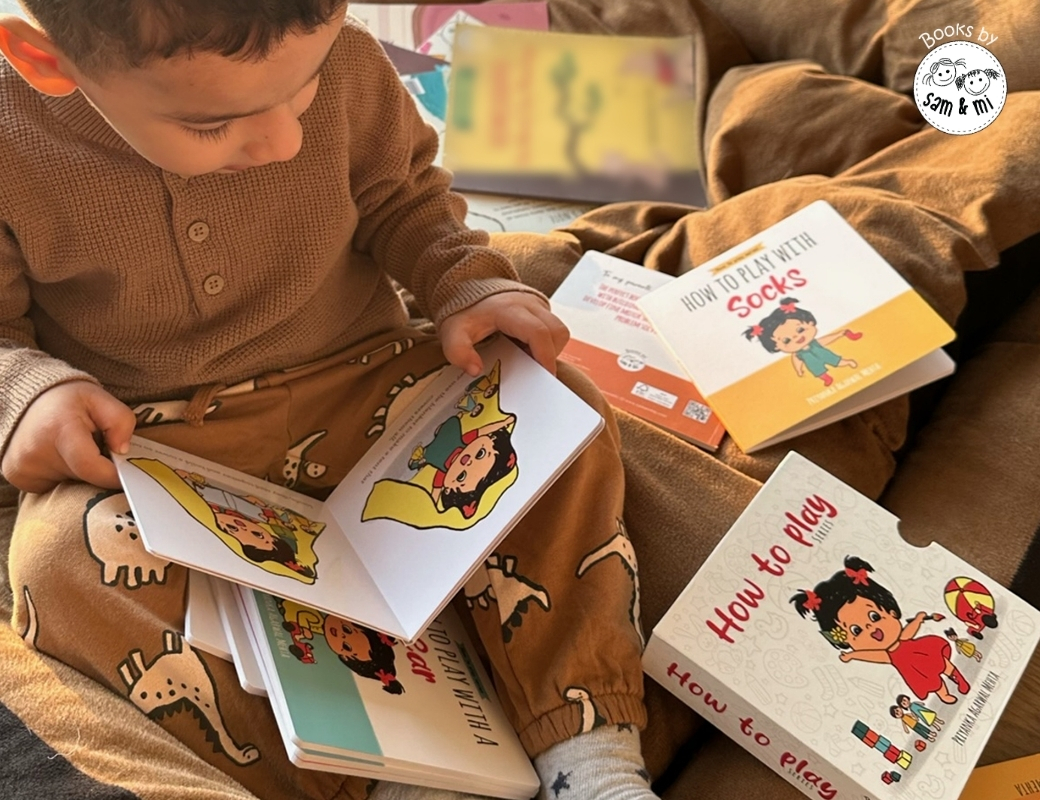
Our books 'How to Play' for 0-3-year-olds and 'Adventures of Samara and Alphabet' for 3-6-year-olds lay the foundation of creative thinking through play techniques and imagination.
'How to Play' gives the child prompts and clues to creatively use playthings and other objects found in our homes, such as blocks and socks. This allows them to expand on their existing knowledge independently.
The Adventures of Samara and Alphabet series uses creative problem-solving techniques to help the child understand the root cause of a problem and brainstorm solutions.
How can we inculcate creative thinking in our kids? Here are a few easy ways:
- Allow them to take things apart: I could have gasped at my daughter taking apart the tiles, but then I would have taken away from the time she put in to investigate how magna tiles work
- Delay clean-up time: When we ask children to clean up after every game, we take away the opportunity for them to combine different toys.
- Be a part of it: When we indulge in creative thinking with our children, they do it more freely and understand that we expect it from them. We have created a messy corner at home where the kids are allowed to use paint, water and all that without a care. And it is easy for them to clean it up. I also use these phrases a lot, “I love you messy” or “I love how you figured out a new use for this”
- Encourage ‘I have an idea’: When children pose a problem, don’t jump in to solve it. Instead, ask them to identify the root cause and discover ways to solve it!
- Show them how you do it: Children know how to solve big problems in a simple way. Share some of your work or domestic issues with them and ask them to help solve them. And see the smile of satisfaction on their faces from being helpful!
- Do try this with your child, and let me know how it works out! Do write to me with stories of your children’s creative adventures!
I hope you have had a great start to this new year, and I wish you a year full of creative journeys with your child.
With love always,
Priyanka

Priyanka Agarwal Mehta
Priyanka is a mother to two vivacious girls and most of her books stem from the interactions she has with her daughters. Her books include subtle themes of empathy, problem solving and communication skills - capabilities that she considers key to a happy and successful life. She holds a BA from Northwestern University in the US and a MBA from University of Cambridge in the UK. She sits on the board of several educational institutions. She spends most of her time writing books and running an educational technology company.