 6 min read
 Step-by-Step IVF Process Explained Simply
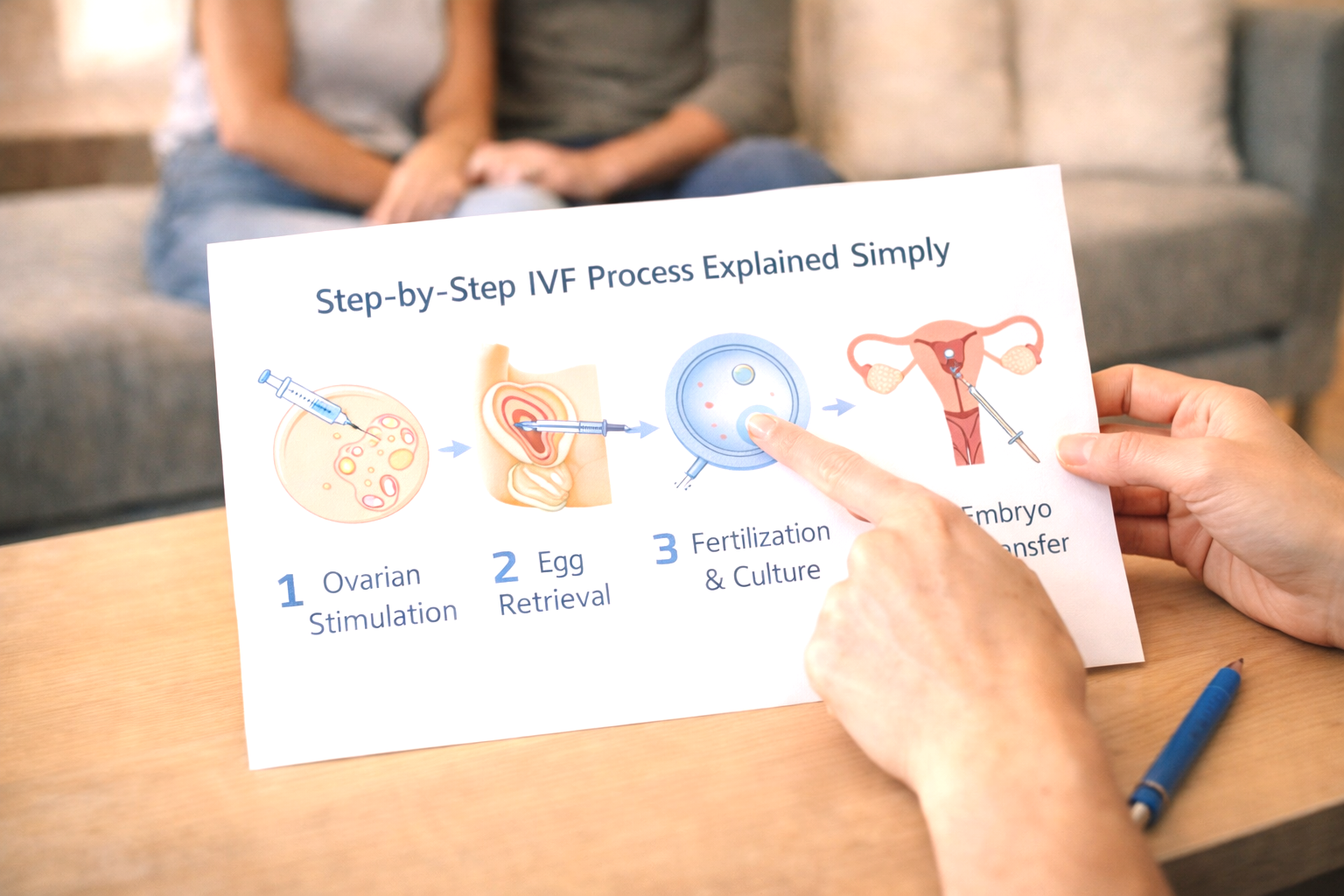
Curious about how IVF actually happens? The process may seem complex, but it can be understood in a simple way. This guide walks you through each stage in an easy manner, helping you know what happens during treatment and what couples usually experience along the way.
When people first hear about IVF, the biggest source of anxiety is not always the outcome—it’s the unknown. Words like “procedure,” “cycle,” and “transfer” can make everything feel complicated and overwhelming.
But here’s the truth: once you understand the IVF process step by step, it starts to feel far more manageable. It’s not a single event—it’s a series of small, carefully planned stages. Each one has a purpose. Each one moves you forward.
This guide is here to walk you through that journey in a simple, clear, and human way— so you know exactly what to expect, without feeling lost in medical language.
Before the Process Even Begins
IVF doesn’t start suddenly. There’s always a preparation phase. Before any treatment begins, doctors need to understand your body and your fertility health. This usually involves a combination of basic tests and conversations.
You may go through:
-
Blood tests to check hormone levels
-
Ultrasounds to look at the ovaries and uterus
-
Semen analysis (for male partner)
-
Discussion of medical history
This stage is not about rushing—it’s about building clarity. It helps doctors create a plan that suits your specific situation, not a one-size-fits-all approach.
Step 1: Preparing the Body for IVF
Once everything is assessed, the first active step begins—preparing the body.
In some cases, doctors may regulate your cycle using medication before starting IVF. This helps bring better control over timing and improves how the body responds later. Think of this stage as setting the foundation. Nothing dramatic happens yet, but it’s important for what follows.
Step 2: Ovarian Stimulation (Encouraging More Eggs)
In a natural cycle, the body releases one egg. But IVF works best when multiple eggs are available, because it increases the chances of creating healthy embryos. So, the ovaries are gently stimulated using hormone injections over an average of 10-12 days. This part can feel new or slightly uncomfortable at first, especially if you’re not used to injections. But most people adjust quickly once they get into the routine.
During this phase:
-
The body is encouraged to develop multiple follicles (which contain eggs)
-
You may have regular check-ups to track progress
-
Dosages may be adjusted depending on how your body responds
This stage is active, but controlled. You’re not left guessing—everything is monitored closely.
Step 3: Monitoring and Tracking Growth
As the eggs develop, doctors keep a close watch on their progress. You’ll likely visit the clinic every few days for:
-
Ultrasound scans to measure follicle size
-
Blood tests to check hormone levels
This helps determine when the eggs are ready for retrieval. Timing is everything here. If done too early or too late, it can affect the outcome. So this stage is all about precision. For many people, this phase builds anticipation—you can see progress happening.
Step 4: Trigger Shot (Final Maturation)
Once the follicles reach the right size, a “trigger shot” is given. This injection helps the eggs mature fully and prepares them for collection. What makes this step important is timing. Egg retrieval is scheduled very precisely after this injection—usually within 34– 36 hours. It’s a small step, but a crucial turning point in the process.
Step 5: Egg Retrieval (Collection Day)
This is one of the most talked-about steps—and often the one people feel nervous about. Egg retrieval is a minor procedure where the doctor collects eggs from the ovaries using a thin needle, guided by ultrasound.
Here’s what you can expect:
-
It is done under sedation, so you won’t feel pain during the procedure
-
It usually takes about 15–20 minutes
-
You can go home the same day
After the procedure, you might feel mild cramping or tiredness, but most people recover quickly. Emotionally, this day often feels significant—it’s the first major milestone in the IVF journey.
Step 6: Sperm Collection
On the same day as egg retrieval, a sperm sample is collected. In some cases, if there are specific challenges, sperm may be retrieved through medical techniques. But in most situations, it’s a simple process. The goal is to have both egg and sperm ready at the same time for fertilization.
Step 7: Fertilization (Where It All Begins)
Now comes the moment where science steps in quietly and precisely. The collected eggs and sperm are brought together in a laboratory. Fertilization happens under controlled conditions.
There are two main ways this may happen:
-
Eggs and sperm are mixed naturally in a dish (IVF)
-
A single sperm is injected directly into an egg (ICSI)
If fertilization is successful, embryos begin to form. This stage is often invisible to patients—but emotionally, it carries a lot of hope.
Step 8: Embryo Development (Watching Growth)
Over the next few days, the embryos are carefully observed as they grow. Not every fertilized egg becomes a strong embryo. This is completely normal.
Doctors and Embryologists monitor:
-
How the cells are dividing
-
The overall quality of the embryos
-
Which ones are developing best
By day 3 to day 5, a decision is made about which embryo(s) are suitable for transfer. This stage requires patience—it’s a waiting period filled with quiet anticipation.
Step 9: Embryo Transfer (A Gentle Procedure)
Once a healthy embryo is selected, it is placed into the uterus. This is a simple and usually painless procedure. It does not require anaesthesia and is often compared to a routine medical exam. A thin tube like catheter is used to carefully transfer the embryo into the uterus. It’s a short moment, but emotionally, it can feel very powerful. For many, this is the moment where hope feels most real.
Step 10: After Transfer (Supporting the Body)
After the embryo is transferred, the body is supported with medications—usually hormones—to help create the right environment for implantation.
You may be advised to:
-
Avoid heavy physical strain
-
Continue medications as prescribed
-
Maintain a calm and balanced routine
Contrary to common belief, strict bed rest is usually not necessary. Normal, gentle daily activity is often allowed.
Step 11: The Two-Week Wait
This is often described as the hardest part of the IVF journey. After the embryo transfer, there is a waiting period of about 10–14 days before taking a pregnancy test.
During this time:
-
You may notice small changes in your body
-
You may feel hopeful one moment and anxious the next
-
Every symptom (or lack of it) may feel significant
This phase is less about medical action and more about emotional endurance.
Step 12: Pregnancy Test and Results
At the end of the waiting period, a blood test is done to confirm whether pregnancy has occurred. This moment carries a mix of emotions—hope, fear, excitement, and vulnerability. If the result is positive, the journey continues into early pregnancy care. If the result is negative, doctors discuss the next steps, which may include trying again with the advance technology available or adjusting the approach.
How Long Does the Whole Process Take?
A full IVF cycle usually takes about 4 to 6 weeks in fresh cycle or in cases of frozen embryo transfer, it can take 2-3 months , wherein conditions like adenomyosis, fibroids or endometriosis are treated first and this is followed by embryo transfer.. However, the emotional journey can feel longer because of the waiting periods between steps. It’s not just a timeline—it’s an experience.
What Makes Every IVF Journey Different?
Even though the steps are similar, no two IVF journeys are exactly the same.
Differences can come from:
- Age and health conditions
- How the body responds to medication
- Number and quality of eggs retrieved
- Sperm Quality and it’s DNA damage
- Embryo development
- Couple’s lifestyle
This is why comparing journeys can sometimes create unnecessary stress. Your path is your own.
Common Feelings During the Process
As you move through IVF, it’s normal to experience a mix of emotions.
You might feel:
-
Excited at the beginning
-
Nervous before procedures
-
Hopeful during embryo development
-
Restless during the waiting phase
These feelings are not signs of weakness—they are part of being human in a deeply meaningful journey.
A Simple Way to Think About IVF
If the process still feels overwhelming, here’s a simple way to look at it:
-
The body is supported to produce more eggs
-
Eggs are collected safely
-
Fertilization happens in a lab
-
A healthy embryo is placed back into the uterus ● The body is given time and support to allow pregnancy
That’s the entire process—broken into small, manageable steps.
Closing Thoughts
IVF is not a single big moment—it’s a series of small, thoughtful steps that come together with care and precision. Understanding these steps doesn’t remove all the uncertainty, but it replaces confusion with clarity. And that alone can make a big difference in how you experience the journey. If you’re considering IVF or just learning about it, remember this: you don’t have to carry all the information at once. Take it step by step—just like the process itself.
Each stage has its own purpose. Each step brings you closer to understanding, and possibly, to parenthood. And wherever you are in this journey, you’re not alone in it.

Dr. Sanyukta Jaju
Dr. Sanyukta Jaju is a dedicated Consultant Gynecologist and IVF Specialist with extensive expertise in reproductive health. She holds an MBBS, MS, and DNB in Obstetrics & Gynecology, along with a Fellowship in Reproductive Medicine and an Executive Diploma in Adolescent Health Counseling. With a strong focus on evidence-based care and compassionate practice, she is committed to guiding women and couples through every stage of their fertility and health journey. As a mother of two, Dr. Sanyukta brings not only clinical excellence but also a deep personal understanding to her approach, making her insights especially valuable for platforms focused on parenting, adolescent health and infertility.