 5 min read
 Screens vs Imagination: What Happens at Age 4–6?
Between ages 4 and 6, children start using imagination to learn, create, and solve small problems. Too much screen use can limit this natural thinking, as ready-made visuals replace their own ideas. This stage is important for creativity, storytelling, and exploring the world in their own unique way.

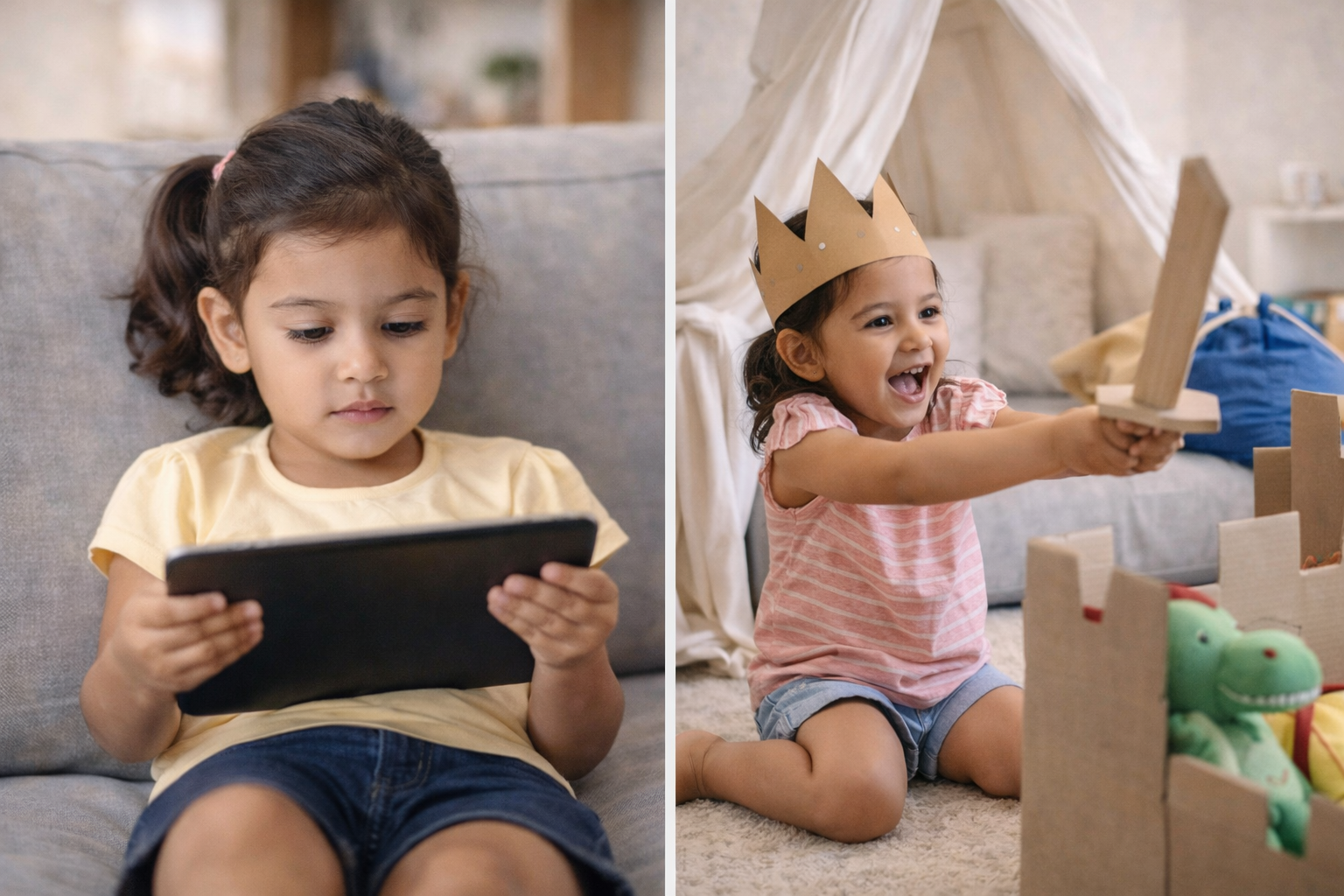
There’s something truly beautiful about a child between the ages of four and six. Give them a simple cardboard box, and it becomes a spaceship. A spoon turns into a microphone. A bedsheet becomes a superhero cape.
This is the age where imagination doesn’t just exist—it explodes. But now, place a screen in front of that same child. Suddenly, the story is already created. The characters already defined. The adventure already designed. And the child shifts from being a creator… to a viewer. This is where a subtle but powerful change begins.
Because between the ages of 4–6, imagination is not just play—it is development. And the growing presence of screens can quietly reshape how this imagination forms.
Why Ages 4–6 Are So Crucial for Imagination
Preschool years are often called the “golden years of imagination.”
At this stage, children begin to:
- Create stories on their own
- Engage in pretend play
- Assign roles and characters
- Build imaginary worlds
- Experiment with “what if” thinking
This kind of play is not random. It is deeply connected to brain development.
When a child imagines, they are:
- Strengthening creativity
- Building problem-solving skills
- Developing emotional understanding
- Practicing language and storytelling
- Learning to think beyond the obvious
In simple words, imagination is how children learn to think.
The Core Difference: Creating vs Consuming
Let’s understand the fundamental difference between imagination and screen-based entertainment.
Imagination is active. Screens are passive.
When a child plays pretend, they:
- Decide what the story is
- Choose what happens next
- Adjust based on their thoughts
- Stay mentally involved
But when watching a screen:
- The story is already made
- The pace is controlled externally
- The child follows, not leads
- There is little need to think ahead
This shift—from creating to consuming—is the heart of the issue. Over time, if screens dominate, children may rely less on their own imagination and more on external content for stimulation.
What Happens Inside the Child’s Mind
At ages 4–6, the brain is rapidly developing connections related to creativity and abstract thinking. When children engage in imaginative play, different parts of the brain work together. They visualize, plan, act, and respond—all at once. But screens simplify this process.
The visuals are already provided. The sounds are ready. The storyline is fixed. This reduces the need for the brain to “fill in the gaps.” And those gaps are exactly where imagination grows.
The Subtle Impact of Screens on Imagination
The effect of screens is not always immediate or obvious. A child who watches cartoons may still play. They may still imagine. But over time, certain patterns can begin to appear.
You might notice:
- Stories becoming repetitive or copied from shows
- Less interest in independent play
- Difficulty starting play without guidance
- Reduced creativity in storytelling
- Preference for screen-based entertainment over pretend play
These are not sudden changes. They develop gradually as screens become a primary source of engagement.
When Imagination Gets Replaced
One of the biggest risks is not that imagination disappears—but that it gets replaced.
Instead of creating their own characters, children may:
- Imitate cartoon characters exactly
- Repeat dialogues from shows
- Recreate scenes instead of inventing new ones
Now imitation is not bad—it’s part of learning. But when imitation dominates over creation, imagination takes a back seat. The child begins to depend on “ready-made” ideas instead of generating their own.
The Role of Boredom in Imagination
Here’s something most people don’t realize:
Imagination often begins with boredom.
When a child has nothing to do, their brain starts searching for ideas.
That’s when:
- A stick becomes a sword
- A chair becomes a car
- A room becomes an entire world
But screens remove boredom instantly. The moment a child feels restless, a screen fills that gap with entertainment. And over time, the child may stop developing the ability to create their own fun.
Emotional and Social Growth Through Imagination
Imagination is not just about creativity—it is also deeply emotional.
When children play pretend, they:
- Act out real-life situations
- Express feelings they don’t yet understand
- Practice social roles (parent, teacher, doctor, friend)
- Learn empathy by “being someone else”
This kind of play helps them process the world around them. Screens, however, present emotions in a fixed way. The child observes, but doesn’t experience or practice those emotions in the same depth.
Attention, Patience, and Story-Building
Imagination teaches children something very important—how to stay with a thought.
When a child creates a story, they:
- Build it step by step
- Stay engaged in the same idea
- Expand it over time
This builds attention, patience, and mental endurance. Screens, on the other hand, often move quickly. Scenes change fast. Stories progress rapidly. This can make slower, self-created play feel less exciting. And over time, children may struggle to stay engaged in activities that require sustained imagination.
Are All Screens Harmful?
Let’s pause here and bring in some balance. Not all screen time is harmful. The issue is not screens themselves—it’s how they are used.
For example:
- Watching occasionally vs watching daily for long hours
- Watching together with discussion vs watching alone passively
- Choosing slower, meaningful content vs fast-paced stimulation
Screens can be a tool—but they should not replace real-world play.
Finding the Right Balance
At this stage, the goal is not to eliminate screens completely, but to protect imagination.
A healthy balance looks like:
- More time spent in open-ended play
- Opportunities for creative expression
- Limited and intentional screen use
- Encouragement to “create” rather than just watch
Simple activities like drawing, storytelling, role-play, and outdoor play can naturally strengthen imagination. And the best part? They don’t require expensive toys or setups.
What Parents Can Do (Without Overcomplicating It)
You don’t need a perfect system to support your child’s imagination. Small, consistent actions make a big difference.
You can:
- Let your child play without structured instructions
- Join their pretend play occasionally
- Ask open-ended questions like “What happens next?”
- Encourage storytelling instead of giving ready answers
- Allow a little boredom instead of filling every gap
These are simple shifts, but they create space for imagination to grow.
A Realistic View for Modern Parents
Let’s be honest—today’s children are growing up in a world full of screens. Avoiding them completely is not practical. And sometimes, screens are helpful. They give parents a break. They keep children occupied.
This blog is not about removing screens—it’s about being mindful of what they might replace. If screens take up all the free time, imagination gets less room. If imagination is given priority, screens naturally become secondary.
Final Thoughts: Protecting the Magic of Childhood
The ages of 4–6 are not just about learning numbers or letters. They are about building the ability to think, imagine, and create.
A child who learns to imagine can:
- Solve problems creatively
- Express themselves better
- Adapt to new situations
- Think independently
And these are skills that last far beyond childhood.
Screens can entertain. They can teach certain things. But they cannot replace the magic of a child creating their own world. So the next time your child says, “I’m bored,” pause before reaching for a screen.
Because that moment of boredom might just be the beginning of something magical. A story. A game. An entire imaginary world. And in that world, your child is not just watching.They are creating.

Parent With Purpose
Parent with Purpose is your trusted parenting resource, offering expert advice, practical tips, and real experiences from fellow parents. Our content is organized by your child’s age, from pregnancy to the teen years, ensuring guidance that’s relevant to your current stage. Learn through articles, videos, podcasts, and courses that fit your lifestyle. We also provide carefully curated book lists, meal plans, product recommendations, and India-focused resources to make parenting easier and more informed.