 5 min read
 Ovulation Tracking 101: What Every Woman Trying to Conceive Should Actually Know (Week 2 of Your Cycle)
You've decided you're ready to start a family or maybe you've been trying for a few months and feel like you're missing something. Either way, you've heard about ovulation tracking, and now you're wondering: does it actually work, and where do I even begin?
Here's the truth: ovulation tracking is one of the most powerful tools you have when you're trying to conceive but only if you use it the right way. Let's break it all down. What's Actually Happening in Week 2 of Your Cycle? Here's something a lot of women don't realize: "Week 2 of pregnancy" on a standard 40-week pregnancy calendar actually refers to before you're pregnant. It corresponds to the time leading up to ovulation in your menstrual cycle the most important window if you're trying to conceive.
In a typical 28-day cycle, ovulation occurs around Day 14 roughly 14 days before your next expected period. But here's the catch: cycles vary. Yours might be 26 days or 32 days. Ovulation might happen on Day 11 or Day 17. This is exactly why "just track your period" isn't always enough.Your fertile window spans approximately six days: the five days before ovulation and the day of ovulation itself. Of those six days, the two to three days just before ovulation are your golden window. Sperm can live inside the female reproductive tract for up to five days, so having intercourse before ovulation not just during significantly boosts your chances.Think of it this way: You're not aiming to catch ovulation after it happens. You're trying to have sperm waiting and ready when ovulation occurs.
The Signals Your Body Sends (And How to Read Them)
Your body doesn't stay silent before ovulation. Once you know what to look for, you'll be surprised at how communicative your cycle actually is.
1. Cervical Mucus Changes
This is one of the most reliable and free signs of approaching ovulation. As estrogen rises in the days before ovulation, cervical mucus transforms from dry or sticky (post-period) to creamy, then to clear, stretchy, and slippery often compared to raw egg whites. This "egg white cervical mucus" (EWCM) is your body's green light.
How to check: After washing your hands, gently insert a finger and observe the texture and color of the mucus. Do this daily and note your observations in a simple log or app.
2. Basal Body Temperature (BBT)
Your resting body temperature rises slightly (about 0.2°C or 0.4°F) after ovulation due to progesterone. This means BBT is a confirmatory sign, not a predictive one by the time your temperature rises, ovulation has already occurred. Still, tracking BBT over several cycles helps you identify your personal pattern and confirms that ovulation is actually happening.
Tip: Take your temperature every morning at the same time, before getting out of bed or checking your phone. Use a basal thermometer (not a regular one the precision matters).
3. Ovulation Predictor Kits (OPKs)
OPKs detect the LH surge a spike in luteinizing hormone that triggers ovulation within 12–36 hours. This makes OPKs the most precise at-home method for predicting ovulation before it happens, giving you actionable timing.
How to use them effectively:
- Test at the same time each day (mid-morning or early afternoon is often recommended not first morning urine, which can be too concentrated)
- Start testing a few days before your estimated fertile window (your app or cycle history can guide this)
- A positive result means ovulation is likely within the next day or two this is your prime window
The Three-Layer System That Actually Works
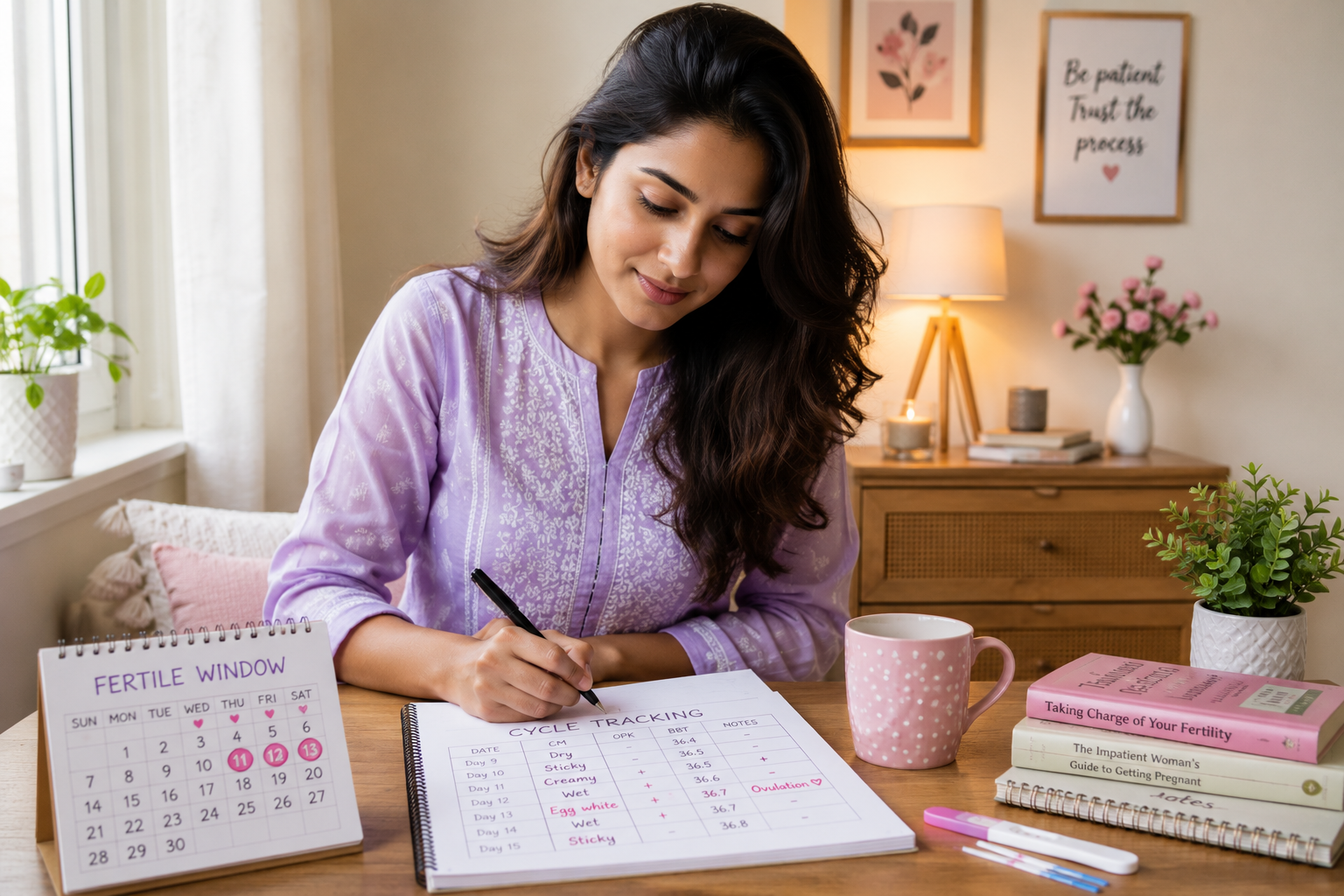
Instead of relying on just one method, use all three together for the most complete picture: LayerWhat It DoesWhen It HelpsPeriod-tracking appSpots long-term trendsPredicts your window each cycleCervical mucus observationReal-time fertility signalNarrows the fertile window day by dayOvulation predictor kitsPinpoints LH surgeConfirms the 24–36 hours before ovulation Practical example: Your app predicts ovulation around Day 14. You start noticing egg-white mucus on Day 12. You test with an OPK on Day 12 negative. Day 13 positive. You now know: today and tomorrow are your most fertile days.This is the system that transforms guesswork into informed timing.
When to Have Sex (The Honest Answer)
Forget waiting for the "exact" moment of ovulation. A practical, low-pressure approach that works for most couples is having sex every other day during the fertile window, especially in the days leading up to your predicted ovulation.This approach:Keeps sperm counts healthy (daily sex can reduce concentration)Reduces the pressure of hitting a single "target day"Gives you multiple chances across the fertile windowIf you're using OPKs and get a positive, aim for intercourse that day and the following day.
Common Mistakes to Avoid
Trusting the app blindly. Apps predict based on past cycles, but ovulation can shift due to stress, illness, travel, or sleep changes. Use the app as a starting estimate, not a final answer.Confusing ovulation symptoms with other things. Bloating, breast tenderness, and mild cramping (called Mittelschmerz) can signal ovulation but they can also be caused by many other things. Never rely on symptoms alone.Making it too clinical and stressful. This is real. Many women describe a point where tracking becomes obsessive checking symptoms multiple times a day, testing with OPKs twice daily, calculating and recalculating. If tracking starts to feel like a second job or is affecting your relationship, dial it back. The goal is better timing, not perfect control.
FAQs: The Questions You're Actually Googling
Q: Which ovulation tracking method is most accurate?
Ovulation predictor kits are generally the most precise at-home option for detecting your upcoming ovulation (via the LH surge). Cervical mucus and BBT are best used alongside OPKs to build a fuller picture of your cycle over time.
Q: Can I just use an app and skip the rest?
Apps are genuinely helpful for spotting trends and estimating your window but they work best when paired with at least one body-based sign (mucus or OPKs). Cycles change month to month, and apps can't detect that in real time.
Q: What if my cycles are irregular?
Irregular cycles make calendar-based prediction unreliable. In this case, cervical mucus observation and OPKs are even more valuable because they respond to your actual hormones, not a calendar average. If your cycles vary significantly (more than 7–10 days difference), consider talking to a gynecologist or fertility specialist who can offer ultrasound monitoring or bloodwork to pinpoint ovulation more precisely.
Q: How long should I track before seeing a doctor?
The general guideline is: if you're under 35 and have been trying for 12 months without success, or over 35 and trying for 6 months, it's worth consulting a fertility specialist. If your cycles are irregular or you're not seeing any fertile signs at all, it's reasonable to seek guidance sooner.
Your Simple Action Plan: Start This Cycle
- Download a period-tracking app (Clue, Flo, and Kindara are popular options) and log your last few periods if you remember them.
- Start observing cervical mucus daily just a 10-second check each morning.
- Get a pack of OPKs and start testing 2–3 days before your app estimates your fertile window begins.
- Keep a simple log just jot down: period dates, mucus changes, OPK results, and when you had intercourse. After 2–3 cycles, you'll see your personal pattern clearly.
- Take the pressure off. You're not failing if it takes a few cycles to understand your body. Most couples conceive within 6–12 months of trying, and learning your cycle is progress, not delay.
Ovulation tracking isn't about achieving perfect control of your body it's about understanding it better. Once you know your pattern, you stop guessing and start working with your cycle instead of against it. Week 2 of your cycle is arguably the most important week when you're trying to conceive. The fertile window is real, the signs are there, and with the right tools a tracking app, a bit of mucus observation, and an OPK when you want precision you can find your window and make the most of it. Give yourself grace. Give yourself information. And give yourself time.
Dr. Sanyukta Jaju
Dr. Sanyukta Jaju is a dedicated Consultant Gynecologist and IVF Specialist with extensive expertise in reproductive health. She holds an MBBS, MS, and DNB in Obstetrics & Gynecology, along with a Fellowship in Reproductive Medicine and an Executive Diploma in Adolescent Health Counseling. With a strong focus on evidence-based care and compassionate practice, she is committed to guiding women and couples through every stage of their fertility and health journey. As a mother of two, Dr. Sanyukta brings not only clinical excellence but also a deep personal understanding to her approach, making her insights especially valuable for platforms focused on parenting, adolescent health and infertility.