 7 min read
 The Hidden Effects of Screen Time on Your Child's Mental Health
Your child hasn't said anything wrong. Hasn't misbehaved. Hasn't failed a test. But something feels... off. They seem distant. A little irritable. They don't want to go out and play like they used to. They snap at small things. They look sad sometimes, and when you ask what's wrong, they say "nothing" -and go back to their phone.




Your child hasn't said anything wrong. Hasn't misbehaved. Hasn't failed a test.
But something feels... off.
They seem distant. A little irritable. They don't want to go out and play like they used to. They snap at small things. They look sad sometimes, and when you ask what's wrong, they say "nothing" - and go back to their phone.
Most parents in India dismiss this as "just a phase" or "teenage mood swings" or "too much pressure from school."
But what if the phone itself is the problem? Not in an obvious, dramatic way - but quietly, invisibly, over months?
This is the part of the screen time conversation that most people aren't having. We talk about grades, sleep, eye strain. We rarely talk about what excessive screen time is doing to a child's mind - their anxiety levels, their sense of self-worth, their ability to feel happy in real life.
Let's talk about it today.
|
A Story From My Coaching Room A father came to me deeply confused. His 13-year-old daughter - bright, social, always cheerful - had become withdrawn over the past year. She had stopped going for her dance class, made excuses to avoid family gatherings, and spent most of her time in her room on Instagram and YouTube. "She used to be the life of every room," he said. "Now she barely looks up when we call her for dinner." What struck me was that nobody had connected the dots. The school said she was fine academically. The family assumed it was adolescence. But when we looked carefully, the shift had happened gradually, in parallel with her phone usage going from 1 hour to 5-6 hours a day. She wasn't just consuming content. She was constantly comparing herself - her looks, her life, her marks - to curated, filtered versions of other girls her age. And she was losing. Every single day, in her own mind. Within two months of working together as a family - setting boundaries, rebuilding offline rituals, and most importantly, the father choosing to understand her world instead of judge it - she rejoined her dance class. She told her father: "I didn't realise how tired I was feeling all the time." |
What "Hidden" Really Means
When we say hidden effects, we don't mean rare or extreme. We mean the ones that build slowly - so slowly that by the time you notice them, they've already settled in.
Unlike a broken arm or a fever, mental health changes in children don't come with obvious symptoms. They come as:
-
A child who used to love drawing but "doesn't feel like it" anymore
-
A teenager who avoids family conversations but is very active online
-
A 9-year-old who has meltdowns over small things - losing a game, a plan changing
-
A child who keeps asking "Am I fat?" or "Am I pretty?" after spending time on YouTube
-
A child who is always bored, never satisfied, always wanting more
These are not personality traits. These are signals.
The Six Hidden Mental Health Effects of Excessive Screen Time
1. Anxiety That Has No Name
Research published in 2025 studying Indian school children found a significant link between screen time and anxiety levels. But here's what's interesting - most children experiencing this anxiety couldn't explain why they felt worried. They just did.
Excessive screen time keeps the brain in a constant state of alertness - the next notification, the next video, the next message. This low-level, chronic stimulation trains the nervous system to be always "on." When the screen is finally put away, the brain doesn't know how to settle. The result is restlessness, worry, and a vague sense of unease that children often can't articulate.
In Indian homes, this often looks like a child who can't sleep, is scared of the dark suddenly, or has "stomach aches" before school that disappear by mid-morning.
2. Low-Grade Depression - Especially After Social Media
Multiple studies, including Indian research, have found a direct link between heavy smartphone use and depressive symptoms in children and adolescents. The connection is especially strong with social media platforms like Instagram, YouTube, and now Snapchat.
Here's the mechanism in simple terms: Social media shows children a highlight reel of other people's lives - the birthday parties, the vacations, the achievements, the "perfect" bodies. A child's brain, still developing and highly impressionable, starts to measure their own ordinary Tuesday against someone else's best Saturday.
They feel less. They look less. Their life seems less.
This is not vanity. This is a genuine psychological process called social comparison, and it is happening to children as young as 8 and 9 years old today in Indian cities.
3. Emotional Dysregulation - The Meltdowns and the Moods
Have you noticed that your child is fine when on the phone - and completely falls apart the moment it's taken away?
That's not manipulation. That's emotional dysregulation.
Screens provide a constant stream of stimulation that essentially does the job of managing emotions for a child. Bored? Scroll. Sad? Watch something funny. Anxious? Play a game. The child never has to sit with a difficult feeling long enough to learn how to handle it.
Over time, the brain loses practice at tolerating discomfort. So when something hard happens in real life - a fight with a friend, a poor mark, a "no" from a parent - the child has no internal tools to cope. The emotional response is disproportionate to the situation. Parents often describe this as their child being "too sensitive" or "overreacting all the time."
They're not overreacting. They're undertrained.
4. Loneliness in the Middle of Connectivity
This one surprises most parents: children who are the most "connected" online are often the loneliest in real life.
Online friendships are real, but they are also thin. They lack the texture of shared physical experience - the inside joke from a cricket match, the comfort of sitting next to a friend, the safety of someone who has seen you cry. When online interaction replaces offline friendship rather than complementing it, children grow up with hundreds of followers and very few people they can actually call when they're in trouble.
Indian children are experiencing this at scale right now. Studies show that children who grow up without strong offline friendships are more vulnerable to loneliness, anxiety, and depression in adulthood.
5. Poor Self-Image and Body Confidence
For girls especially - though increasingly for boys too - screens have become a mirror that always distorts.
Filtered images, beauty tutorials, fitness reels, "glow-up" content - all of it tells a child, repeatedly, that how they naturally look is not enough. The Indian skin tone, the round face, the short height - things that are completely normal and beautiful - become sources of shame when a child's reference point becomes social media.
This is not a small thing. Low body confidence in childhood is directly linked to anxiety, depression, disordered eating, and poor academic performance. It is one of the most significant and least-talked-about consequences of early, unmonitored social media use.
6. Reduced Capacity for Real Joy
Perhaps the most heartbreaking hidden effect is this: children who grow up on heavy screen time gradually lose the ability to feel genuine pleasure from ordinary life.
When the brain is trained on dopamine hits every 30 seconds - a new reel, a game reward, a like on a photo - real life simply cannot compete. A walk in the park, a meal with family, a book, a conversation - these things feel flat, slow, and unsatisfying.
Parents often describe their children as seeming "empty" or "joyless" even when nothing specific is wrong. This is called dopamine desensitisation - and it is reversible, but only if we act early.
|
✦ Ruchira's Take In my coaching practice, the shift I see most often is this: parents come in worried about grades or screen time limits. But when we go deeper, what they're really grieving is their child's spark. The curiosity. The laughter. The child who used to run to tell them something exciting. That quality of aliveness. Screens don't steal it all at once. They dim it, slowly, over time. And the beautiful truth is - it comes back. When children are given the right conditions: presence, connection, boredom, and real experience - the spark returns. That's why this work matters. Not to take something away from our children. But to give them back to themselves. |
What You Can Do - Without Panic
The goal is not to alarm you. The goal is to equip you. Here's where to start:
Watch for the signals, not just the symptoms
You don't need a clinical diagnosis to trust your gut. If your child seems less like themselves - less joyful, more withdrawn, quicker to anger - take it seriously. You know your child best.
Have a conversation, not a confrontation
Don't lead with "You're on your phone too much." Lead with curiosity: "I've noticed you seem a little flat lately. Is everything okay?" Children open up when they feel safe, not accused.
Create more real experiences
The antidote to screen-induced emptiness is not more rules - it's more life. More meals together. More outdoor time. More laughter with cousins. More creative play. More boredom that your child has to solve themselves. Fill the space with something real before you remove something digital.
Limit social media before age 13 - seriously
Most major platforms have a minimum age of 13 for a reason. Indian parents frequently bypass this - buying the phone, setting it up, and handing it over without restriction. The mental health research is clear: early, unmonitored social media use causes measurable harm. Delay it as long as you reasonably can.
Model emotional health yourself
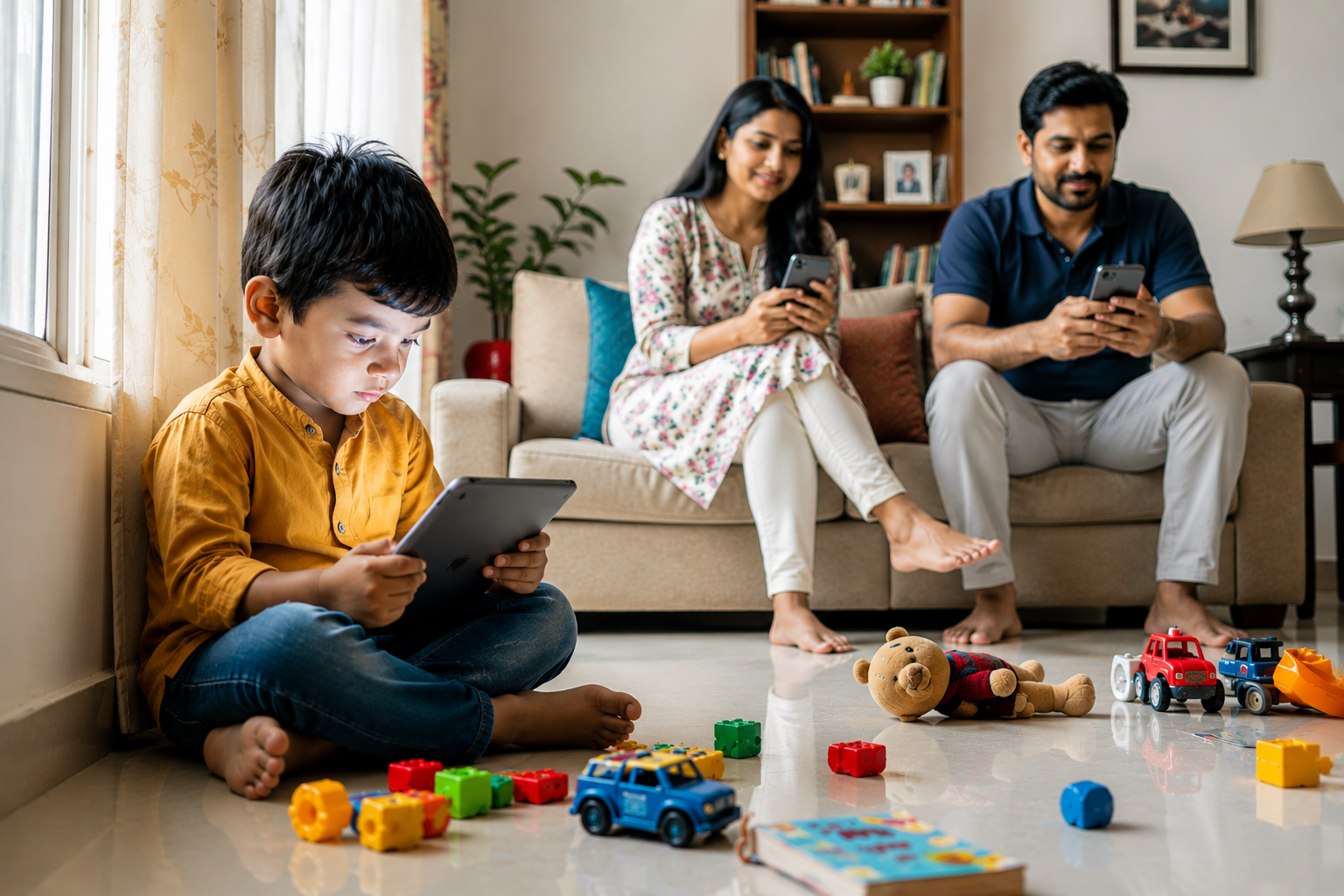
Children learn how to handle their emotions by watching you handle yours. If you reach for your phone every time you feel bored, stressed, or uncomfortable - they will too. The most powerful thing you can do for your child's mental health is to manage your own screen habits consciously.
Quick Signs to Watch For
-
Sudden withdrawal from activities they used to love
-
Increased irritability or emotional outbursts, especially when screens are removed
-
Saying "I'm bored" despite having plenty to do
-
Asking repeatedly about their appearance or comparing themselves to others
-
Difficulty sleeping, or wanting to sleep with the phone nearby
-
Seeming sad, flat, or emotionally "empty" without a clear reason
-
Preferring online interaction strongly over spending time with family or friends in person
If you notice three or more of these consistently over a few weeks, it may be worth a conversation with your child's paediatrician or a counsellor. Early support makes an enormous difference.
A Final Word
Mental health is not a topic for crisis only. It is the quiet, daily work of raising a child who feels secure in themselves, connected to the people they love, and capable of handling real life.
Screens are not the enemy. Unconscious, unguided, unlimited screen use is.
You noticed something was off. You asked. You read this. That is already parenting with purpose.

Ruchira Darda
Ruchira Darda is a certified parenting coach (ACC), NLP Practitioner, author, and the founder of parentwithpurpose.in. She works with families across India through her initiatives WOW, MahaMarathon, and The Yellow Door.