 6 min read
 The Fear Underneath Your Parenting
What Indian parents are most afraid of - and how fear quietly runs the show




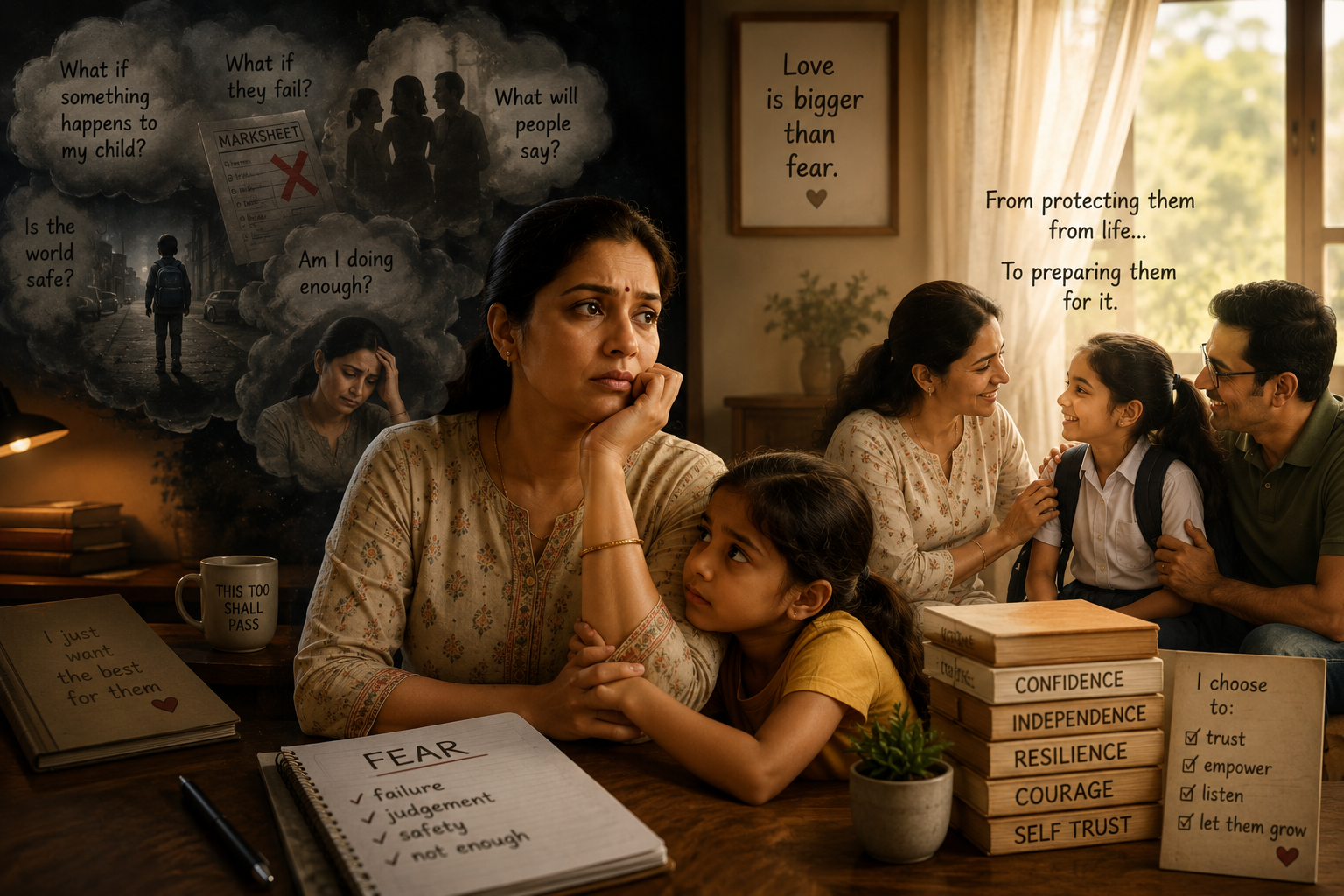
Nobody warns you about the fear. They tell you about the joy - and that is real. They tell you about the exhaustion - and that is real too. But the fear that comes with parenthood is somehow left out of the conversation. Perhaps because naming it feels like ingratitude. Perhaps because it is so large that we learn quickly not to look at it directly.The fear is there from the beginning - the first scan, the first missed kick count, the first fever that runs a degree too high. And it doesn't go away as children grow. It simply changes shape.
This article is about the fear. Not to make it larger, but to make it visible - because fear that is not named runs your parenting silently, from underneath, and the decisions it drives are not always the ones you would choose with a clear head.
|
A Story From My Coaching Room A mother came to me exhausted by her own vigilance. Her 11-year-old daughter was not allowed to walk to school alone, was not allowed to attend sleepovers, and was not permitted to have any social media whatsoever - all of which, the mother acknowledged, were defensible positions individually. But together, they were building a child who was anxious, dependent, and quietly resentful. 'I know I am overprotective,' the mother said. 'But every time I try to give her more freedom, I just think of everything that could go wrong. And I can't.' When we traced the fear carefully, what emerged was not really about her daughter at all. It was about something that had happened to the mother when she was twelve - an experience that had left her with a deep, unprocessed belief that the world was fundamentally unsafe and that a mother's job was to stand between her child and every possible danger. The fear was real. The world is not always safe. But her daughter was growing up inside her mother's unprocessed fear, not inside her own life. We worked on the fear itself - not on the rules. As the mother's relationship with her own past shifted, the rules began to relax naturally. Her daughter started walking to school. Attended a sleepover. Both survived. |
The Fears Indian Parents Carry Most
The fear of their child failing
In India, where educational and professional achievement is deeply tied to family honour, social standing, and - in many families - to a sense of the parents' own worth, a child's failure can feel existential. Not just for the child, but for the parent.This fear drives: excessive academic pressure, comparison with other children, an inability to let a child struggle or fail naturally, and an intensity around marks and performance that communicates, even when words say otherwise, that love is conditional on achievement.
The fear of the world's judgment
What will people say? This question - the kya kahenge log - is perhaps the most powerful invisible force in Indian parenting. It drives choices that have more to do with appearance than with the child's actual wellbeing: the extracurricular activities chosen for their social prestige, the clothes, the school, the birthday parties that cost more than they should. Children raised by the fear of judgment learn to perform for external approval rather than develop their own internal compass. The very thing the parents fear - a child who is inadequate - is more likely to result from parenting driven by the fear of inadequacy.
The fear that something bad will happen
Every parent lives with this fear to some degree. The world is genuinely not entirely safe. Children do get hurt. Terrible things do happen, rarely but really.The question is not whether the fear is rational. It is what we do with it. Fear of danger can be healthy - it makes us careful, watchful, protective. But when the fear becomes chronic, it seeps into every permission, every conversation, every 'be careful' and 'don't do that', and raises a child who absorbs the message that the world is a dangerous place and they are not capable of handling it.
The fear of not being enough
Am I doing this right? Am I giving them enough? Too much? Am I present enough, strict enough, warm enough, consistent enough? This fear is exhausting because it has no endpoint - there is always more that could be done, always another way you could be falling short.It is also the fear most likely to produce the behaviour it is afraid of: a parent so consumed by the anxiety of not being enough that they cannot simply be present, which is the only thing that actually counts.
How Fear Runs Your Parenting
Fear-based parenting looks like love. It feels like love. In many ways it is love - distorted by anxiety into a shape that doesn't serve the child.
- It looks like overprotection - removing every obstacle, fighting every battle, not letting your child fail
- It looks like perfectionism - correcting everything, never satisfied, always raising the bar
- It looks like control - needing to know everything, allowing little independence, constant monitoring
- It looks like comparison - because if your child is the best, the fear of inadequacy is temporarily quieted
- It looks like emotional unavailability - the parent so consumed by managing their own fear that they cannot be present for the child's actual experience
None of this is intentional. All of it is understandable. But children raised inside their parent's fear learn that the world is dangerous, that they are not trusted, and that their worth is conditional. These are not the lessons any parent intends to teach.
Working With Your Fear - Not Against It
Name the specific fear
'I am afraid' is too large to work with. 'I am afraid my son will not get into a good college and his life will be difficult' is specific. 'I am afraid my daughter will be unsafe if I give her more freedom' is specific. Specificity is where you can begin to examine whether the fear is proportionate, where it comes from, and what it is actually asking of you.
Ask: whose fear is this?
Some of what we carry as parents belongs to us, not to our children. The fear of social judgment that drives a particular parenting choice - does it protect your child, or does it protect you? The fear of failure that drives academic pressure - is it about your child's future, or about your own history with failure and what it meant?This question is uncomfortable. It is also clarifying.
Distinguish between protective and limiting fear
Not all fear is harmful. Fear that makes you careful about road safety, about strangers, about genuine danger - this is healthy, functional fear. The question is whether your fear is protecting your child's life or limiting their growth. A useful check: if you remove this restriction or this level of vigilance, what is the realistic worst case? If the realistic worst case is manageable - embarrassment, disappointment, a minor injury - the fear may be doing more harm than the thing it is protecting against.
Build your child's capacity, not just their safety
The antidote to fear-based parenting is not fearless parenting. It is competence-building. A child who knows how to handle difficulty, navigate conflict, recover from failure, and make decisions is genuinely safer in the world than a child who has been protected from all of these experiences.Trust your child with more than you are afraid to. They will surprise you.
|
✦ Ruchira's Take I have been afraid as a parent. Many times, in many ways. I have been afraid of the world my children were entering - the pressure, the speed, the things I could not control. I have been afraid of my own mistakes and what they might cost them. What I have come to understand is that the fear, in its most honest form, is love without enough trust. Trust in the child. Trust in their resilience. Trust in the relationship you have built with them - that it is strong enough to survive the things you cannot prevent. Parenting from trust looks different from parenting from fear. It is less controlling, more curious. Less anxious, more present. Less about preventing the worst, and more about building a child who can face it. That is the shift. From protecting them from life, to preparing them for it. |
This Week
- Name one specific fear that is currently driving a parenting decision
- Ask honestly: whose fear is this - mine or theirs?
- Identify one place where fear is limiting your child's growth rather than protecting their safety
- Give your child one more responsibility or freedom than fear would normally allow - and notice what happens
- Find one trusted person to say the fear out loud to. Named fear is smaller than silent fear.
Your fear comes from love. Let love be bigger than the fear.

Ruchira Darda
Ruchira Darda is a certified parenting coach (ACC), NLP Practitioner, author, and the founder of parentwithpurpose.in. She works with families across India through her initiatives WOW, MahaMarathon, and The Yellow Door.