 5 min read
 Sibling Rivalry Solutions: How to Teach Kids to Resolve Conflict
Your job isn't to stop every fight. It's to teach kids how to fight well and ultimately, how to resolve conflict themselves.This blog gives you a practical, proven roadmap for doing exactly that.

When Your Home Feels Like a Battleground
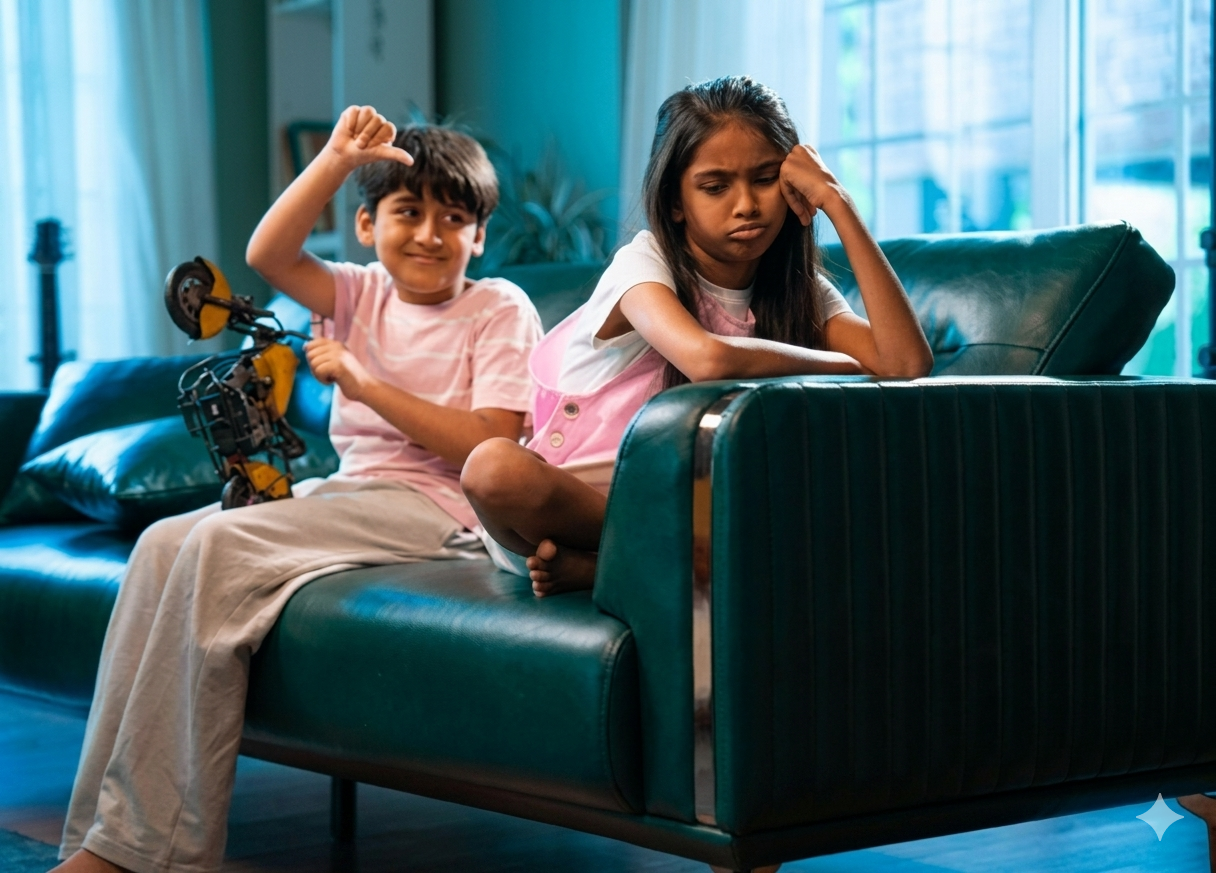
"She touched my stuff!" "He ALWAYS gets to go first!" "That's not FAIR!"If the soundtrack of your home includes a daily (or hourly) sibling conflict, you're in extremely good company. Sibling rivalry is one of the most universal and most exhausting aspects of raising more than one child.But here's what most parenting advice misses: sibling conflict is not a problem to eliminate. It's a skill to develop.
The way children learn to navigate disagreement, advocate for themselves, manage frustration, and repair relationships with their siblings? That's practice for every relationship they'll ever have. The sibling relationship is, in many ways, the most important social training ground of childhood.Your job isn't to stop every fight. It's to teach kids how to fight well and ultimately, how to resolve conflict themselves.This blog gives you a practical, proven roadmap for doing exactly that.
Why Sibling Rivalry Happens (It's More Normal Than You Think)
Before strategies, it helps to understand the why behind sibling conflict. Children fight with siblings because:
- They're competing for the most important resource in their world: parental attention and love. Sibling rivalry is fundamentally about resource competition and that resource is you.
- They're developmentally wired for fairness. Even toddlers have a strong sense of what's equal. Perceived inequality is a reliable trigger.
- They have different developmental needs and abilities which creates constant friction in shared spaces.
- They feel safest fighting at home. Children behave better at school because the relationship stakes are lower. Home is where they let their guard down which means siblings get their rawest emotional expression.
- They lack conflict resolution skills. Arguing, hitting, tattling, and melting down aren't personality flaws they're the immature conflict tools of brains still developing.Understanding this reframes sibling conflict from "my children are broken" to "my children are practicing."
The #1 Parenting Mistake That Fuels Sibling Rivalry
It's the reflex almost every parent has: jumping in to solve the conflict.The moment you rush in, figure out who's wrong, dispense justice, and fix the problem you've done three things:
- Denied your children the chance to practice conflict resolution
- Positioned yourself as a judge (which means every fight becomes a performance for your verdict)
- Ensured the fights continue because they now need you to resolve them
The goal is not to be a better referee. It's to make yourself progressively unnecessary.
6 Sibling Rivalry Solutions That Actually Work
1. Stay Out of It More Than You Think You Should
Unless someone is in physical danger or genuinely upset beyond their capacity to manage, resist the urge to intervene immediately.Give them 30-60 seconds. Watch from a distance. You'll often be surprised children resolve more conflicts on their own than parents realize, when parents aren't present to perform for.When you do step in, step in as a coach, not a judge:"I see there's a problem here. What does each of you need right now?"
Not: "Who started it?" That question guarantees escalation.
2. Avoid Playing Judge Validate Both Sides
When children come to you with sibling complaints, the instinct is to figure out who's right. Resist it.Instead, validate both experiences simultaneously:"It sounds like you felt really left out when she took that. AND it sounds like you wanted to use it too. You both had a real need here."This does something powerful: it removes you from the middle and puts the responsibility for resolution back where it belongs between the siblings.
3. Teach the Conflict Resolution Script
Children fight the way they do because no one taught them a better way. Give them a concrete, repeatable script:
The 3-Step Sibling Conflict Script:
- "I feel _____ when you _____." (No name-calling, no accusations just the feeling and the behavior.)
- "What I need is ___." (Stating the actual need, not the attack.)
- "Can we figure this out together?" (Turning toward each other, not toward the parent.)
Practice this during calm moments not mid-argument. Role-play silly, low-stakes scenarios so the script is familiar before they need it under pressure.
4. Hold Regular Family Meetings
One of the most underused tools in sibling conflict management is the weekly family meeting a brief, structured time where all family members can raise grievances, celebrate wins, and solve recurring problems together.
The format is simple:
- Appreciations each person says something kind about another family member
- Complaints and solutions issues raised by anyone get group problem-solving
- Family business upcoming events, shared decisions
When children have a legitimate forum to raise fairness issues, they feel less need to fight in the moment. And when they help create the family rules around sharing and conflict, they're far more likely to follow them.
5. Treat Them as Individuals, Not a Unit
Much of sibling rivalry is driven by the hunger for individual recognition. When children feel chronically compared, grouped, or treated interchangeably, they fight harder to establish their distinctness.
Counter this by:
- Spending individual one-on-one time with each child regularly even 15 minutes of undivided, child-led time weekly makes a measurable difference
- Avoiding direct comparisons: "Why can't you be more like your sister?" is one of the most corrosive phrases in parenting
- Celebrating individual strengths rather than ranking performance
Children who feel securely seen as individuals have significantly less need to compete with their siblings.
6. Don't Enforce False Fairness Teach Equity Instead
"That's not fair!" is the battle cry of siblings everywhere. Many parents respond by trying to make everything perfectly equal same number of chips, same bedtime, same privileges.This backfires. Because fair doesn't mean equal it means everyone gets what they need.Begin teaching this concept early: "Fair doesn't mean the same. It means what each person needs. You need different things right now."An older child staying up later isn't unfair it's age-appropriate. A child getting extra help with reading isn't favoritism it's meeting a need. When children understand equity vs. equality, the "it's not fair" complaints decrease dramatically.
Age-Specific Sibling Conflict Tips
Toddlers and Preschoolers (Ages 2-5):
- Conflict resolution is beyond their developmental capacity focus on co-regulation first
- Separate the children calmly, without blame
- Use simple language: "Bodies stay safe. Hitting hurts."
- Supervise shared play more closely prevention beats intervention
School-Age Children (Ages 6-11):
- This is the prime window for teaching conflict resolution skills
- Use the 3-step script and family meetings actively
- Involve them in creating household sharing rules
- Debrief after conflicts when everyone is calm
Tweens and Teens (Ages 12+):
- Respect their need to handle conflicts more independently
- Offer to mediate only when invited
- Hold space for sibling processing without taking sides
- Acknowledge that sibling relationships shift and that's okay
When Sibling Conflict Becomes Something More
Most sibling fighting is normal, healthy, and developmental. But watch for signs that it's crossed into something that needs more support:
- One child is consistently the aggressor; the other consistently the victim this is bullying, not rivalry
- Physical violence beyond normal roughhousing hitting, biting, kicking with intent to hurt
- One child showing signs of anxiety, depression, or withdrawal as a result of sibling dynamics
- Conflict so constant it's affecting the whole family's functioning
In these cases, working with a family therapist or child psychologist can provide targeted support.
Final Thoughts: The Goal Is a Lifelong Relationship
It's easy, in the middle of the tenth argument of the day, to forget the bigger picture: your children are building the longest relationship of their lives.Most siblings will know each other for 70, 80, even 90 years. The patterns they learn now how to argue, how to repair, how to share, how to celebrate each other will ripple through that entire relationship.Every conflict you use as a teaching moment rather than a punishment opportunity is an investment in a friendship that will outlast childhood. The siblings who learn to resolve conflict well don't stop fighting they fight, repair, and come back stronger.
That's not dysfunction. That's love with practice.

Parent With Purpose
Parent with Purpose is your trusted parenting resource, offering expert advice, practical tips, and real experiences from fellow parents. Our content is organized by your child’s age, from pregnancy to the teen years, ensuring guidance that’s relevant to your current stage. Learn through articles, videos, podcasts, and courses that fit your lifestyle. We also provide carefully curated book lists, meal plans, product recommendations, and India-focused resources to make parenting easier and more informed.