 6 min read
 If Pornography Becomes Your Son’s First Teacher About Sex
There was a time when parents worried about having "the talk" too early. Today, I...




There was a time when parents worried about having "the talk" too early. Today, I worry that most of us are having it too late.
By the time we gather the courage to speak to our children about their bodies, attraction, consent and relationships, the internet may already have spoken to them. A forwarded video, an innocent search, a pop-up, a social-media link or something shown by a friend may become their first introduction to sex.
This is the uncomfortable question raised by a recent Instagram post: What happens when your son learns about his sexuality through pornography?
It is a question every parent needs to pause over — not because every child who sees pornography will be permanently harmed, and not because curiosity about sex is abnormal. Curiosity is a natural part of growing up. The concern is what children are learning when pornography becomes their primary teacher.
Pornography does not teach intimacy. It teaches performance. It rarely shows communication, tenderness, mutual respect, emotional safety or the ordinary awkwardness of real relationships. It is entertainment created for adults, but children may receive it as information.
When parents remain silent, pornography does not remain "just a video." It can quietly become a child's textbook about bodies, gender, pleasure, power and consent.
Why Children Are Finding Pornography Earlier
Parents often imagine that a child must deliberately search for pornography. That is no longer necessarily true.
Sexually explicit material can appear through social-media algorithms, gaming chats, messaging groups, misleading links and content shared by classmates. A child may first encounter it accidentally. Curiosity may then lead to repeated viewing.
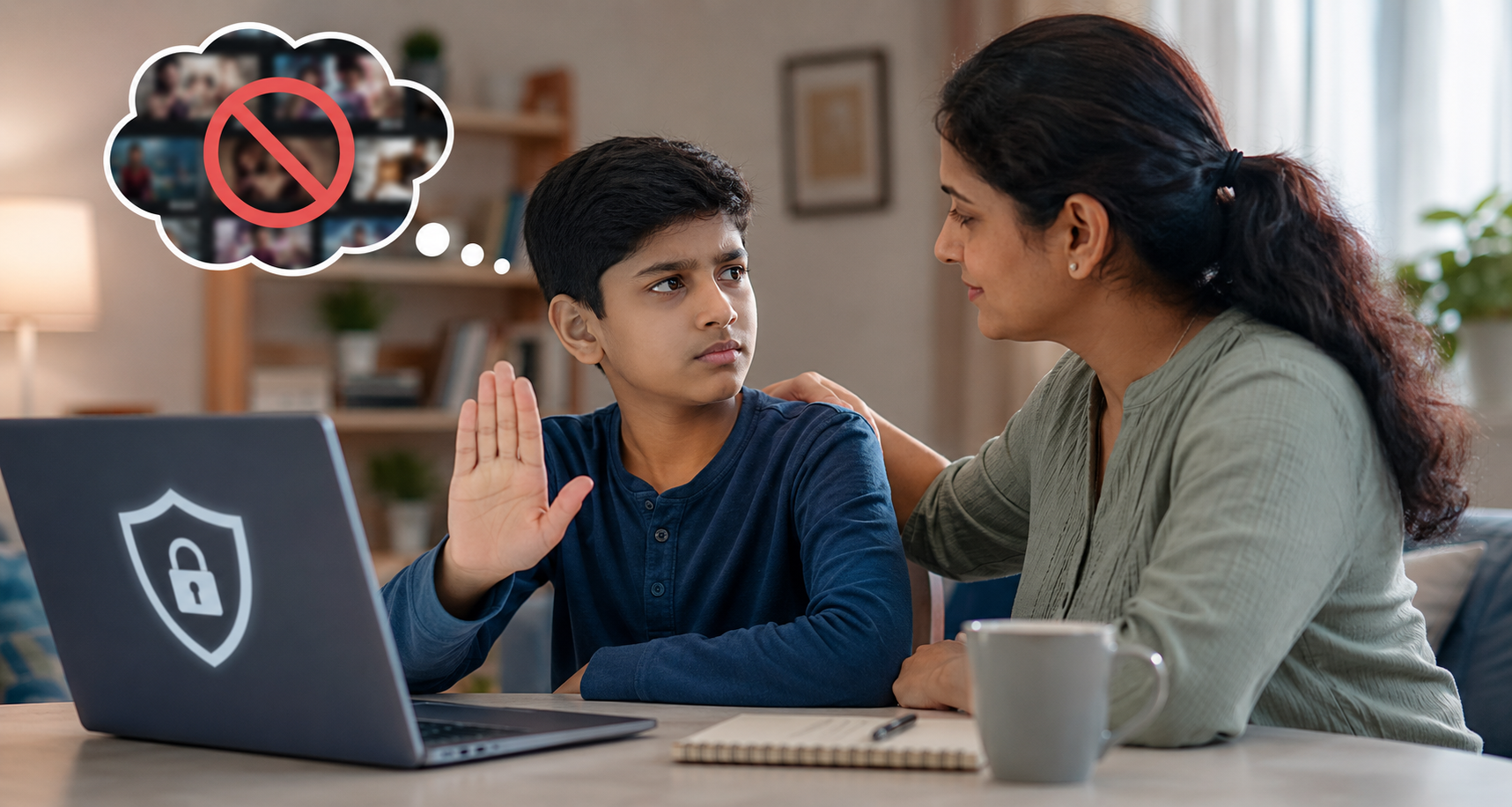
This is why the issue cannot be solved only by taking away a phone. Filters, parental controls and device rules are necessary, especially for younger children, but no digital barrier is perfect. A child will eventually use a friend's phone, encounter a new platform or enter a situation we cannot supervise.
Our strongest protection is not simply control. It is education, connection and the confidence that our children can come to us without being humiliated.
Pornography Is Not Sex Education
Imagine learning to drive only by watching an action film. You would see speed, crashes and dramatic stunts, but you would learn very little about safely navigating an ordinary road.
Pornography offers a similarly distorted education about sex.
It can present unrealistic bodies, exaggerated responses and highly scripted behaviour. It may exclude affection, contraception, consent and emotional consequences. In some content, aggression, humiliation or unequal power may be presented as normal or desirable.
A child does not always possess the emotional maturity or media literacy to say, "This is staged, edited and created to attract attention." What is repeatedly viewed can begin to feel normal, even when it is not representative of healthy intimacy.
A 2023 systematic review found associations between adolescent exposure to pornography and some sexual behaviours and attitudes, while also emphasising that the evidence is complex and that more high-quality research is needed. Culture, frequency of exposure, age, family environment and the child's understanding all matter. Association is not the same as proof that pornography alone causes a particular behaviour. [See Reference 1]
That nuance is important. We should neither dismiss the concern nor frighten parents with exaggerated claims.
What Boys May Begin to Believe
When a boy repeatedly sees women presented as bodies rather than complete human beings, it can affect the scripts he forms about masculinity and relationships.
He may begin to believe that men must always initiate, dominate or perform. He may think that confidence means aggression, that vulnerability is weakness or that another person's discomfort does not require attention unless they explicitly say no.
He may also develop unrealistic expectations of his own body. Boys can become anxious about whether they look, respond or "perform" correctly. Instead of helping them feel confident, pornography can create comparison, pressure and shame.
Research involving young adolescents has found a relationship between pornography use and unequal gender-norm perceptions among boys, although researchers also stress the need for further study. [See Reference 2]
We must also remember that this is not exclusively a boys' issue. Girls may encounter pornography, receive requests for intimate images or absorb messages about what they are expected to tolerate. All children need education about respect, boundaries and digital consent.
Consent Cannot Be Reduced to One Word
Children are often taught that consent means saying "yes" or "no." That is only the beginning.
Healthy consent is:
- Freely given — not the result of pressure, fear or obligation
- Informed — both people understand what is happening
- Mutual — wanted by everyone involved
- Specific — agreeing to one thing is not agreeing to everything
- Reversible — a person can change their mind at any moment
It cannot be assumed because someone agreed earlier, remained silent or did not physically resist.
Children also need to understand that consent applies online. Forwarding someone's private photograph, pressuring a person to send an image, secretly recording them or creating a fake sexual image is a serious violation.
If pornography becomes their teacher, children may never learn these distinctions. We have to teach them that intimacy is not something one person does to another. It involves communication, trust, equality and care.
What Parents Should Not Do
If you discover that your child has seen pornography, your first reaction matters enormously.
- Do not begin with shouting, threats or humiliation.
- Do not call your child dirty, immoral or addicted based on a single incident.
- Do not interrogate them as though they have committed a crime.
- And please do not announce it to other relatives.
Shame does not end curiosity. It simply drives curiosity underground.
The American Academy of Pediatrics recommends calm, non-judgmental conversation when children encounter pornography. It reminds parents that curiosity can be normal and that children should know they are not in trouble for telling the truth. [See Reference 3]
You could begin with:
"I know children sometimes come across adult content online. If that ever happens, you can talk to me."
Or:
"I'm not angry. I just want to understand what you saw and how it made you feel."
A calm response keeps the door open. An explosive response may close it for years.
Have Many Small Conversations
"The talk" should not be one dramatic lecture delivered at puberty. It should be a series of age-appropriate conversations that begin much earlier.
Young children can learn the correct names for body parts, the difference between public and private, and that nobody should ask them to keep a secret involving their body.
Pre-teens can learn about puberty, attraction, online safety, private images and the fact that internet content may be misleading.
Teenagers need honest conversations about relationships, consent, sexual pressure, contraception, pornography, break-ups and respect.
Do not assume that silence preserves innocence. Silence simply allows another source to provide the explanation.
Research on parent-child conversations about pornography suggests that parents commonly face embarrassment, uncertainty and fear of encouraging curiosity. Yet both restrictive strategies and active discussion can play a role. Rules are most effective when accompanied by explanation, trust and media literacy. [See Reference 4]
Teach Your Child to Question What They See
We cannot prepare children for every piece of content, but we can teach them how to think about it.
Ask questions such as:
- "Do you think this was made to show reality or attract views?"
- "Do both people appear equally comfortable and respected?"
- "What is missing from this scene?"
- "Does it show communication, contraception or consequences?"
- "Would this behaviour be acceptable in a healthy relationship?"
These questions turn a frightening subject into an opportunity to build critical thinking.
Children should understand that pornography is performed, edited and often unrealistic. They should know that real bodies are diverse and that healthy relationships cannot be measured against what is shown on a screen.
Create a Family Digital-Safety Plan
Conversation needs to be supported by practical boundaries.
- Keep devices outside bedrooms at night.
- Use age-appropriate filters and safe-search settings.
- Delay unrestricted access to smartphones and social media.
- Know which apps your child uses and who can contact them.
- Discuss what they should do if someone sends sexual content or requests an image.
Make one rule extremely clear: if your child accidentally sees something disturbing, they can close it and come to you. They will not lose their device merely for being honest.
This does not mean there are no consequences for deliberately breaking agreed rules. It means truth will be met first with safety and guidance.
When Should Parents Seek Professional Help?
An isolated exposure is different from a persistent pattern that interferes with daily life.
Consider speaking to a qualified child psychologist, adolescent counsellor or paediatrician if viewing:
- becomes frequent and difficult to control
- affects sleep or studies
- involves increasingly extreme material
- leads to sexualised behaviour that is not age-appropriate
- is accompanied by withdrawal, anxiety, aggression or intense shame
Professional support should not be presented as punishment. The purpose is to understand what the child is seeking — curiosity, comfort, stimulation, escape or peer acceptance — and to build healthier ways of responding.
Become the Trusted Teacher
Our children will learn about sex and relationships. The only question is who will teach them.
Will it be an algorithm? An older classmate? A stranger in a group chat? Or will it be a parent who is willing to move through discomfort to offer honesty, values and safety?
We do not need to give children every detail before they are ready. We do need to give them enough truth that they are not forced to search in unsafe places.
Your child does not need a perfect parent with perfectly rehearsed answers. Your child needs an approachable parent — one who can say, "This may feel awkward, but you can always talk to me."
If pornography has already spoken to your son, it is not too late. Do not allow panic to convince you that everything is lost. Begin the conversation now. Help him separate performance from intimacy, attention from affection, pressure from consent and a screen from a real relationship.
The internet may reach our children before we do. But with connection, courage and consistent conversation, it does not have to remain their most influential teacher.
References
- JMIR — systematic review on adolescent exposure to pornography (2023)
- Journal of Adolescent Health — pornography use and gender-norm perceptions among young adolescents
- American Academy of Pediatrics — guidance for parents on children and pornography
- Research on parent-child communication about pornography

Ruchira Darda
Ruchira Darda is a certified parenting coach (ACC), NLP Practitioner, author, and the founder of parentwithpurpose.in. She works with families across India through her initiatives WOW, MahaMarathon, and The Yellow Door.