 5 min read
 Child Emotional Intelligence: How to Validate Big Feelings Without Giving In
When you learn to do one without the other, you unlock one of the most powerful tools in raising an emotionally intelligent child. This blog will show you exactly how.

One of the most confusing things about gentle parenting and positive discipline is this question: If I validate my child's feelings, aren't I just letting them win?It's a fair concern. And it's also one of the biggest misconceptions in modern parenting. Validating your child's emotions and giving in to their demands are two completely different things. When you learn to do one without the other, you unlock one of the most powerful tools in raising an emotionally intelligent child. This blog will show you exactly how.
Why Emotional Validation Matters in Child Development
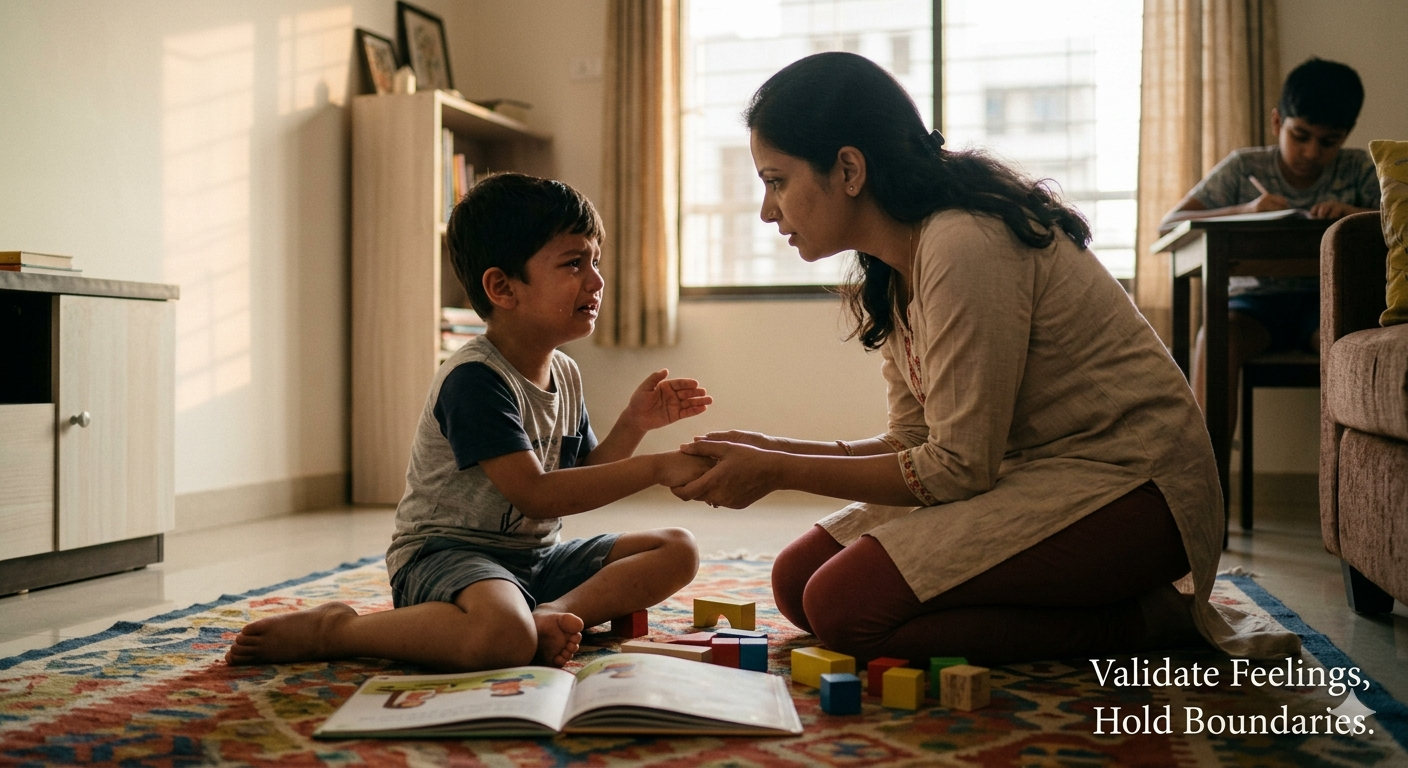
Emotional validation is the act of acknowledging and accepting your child's feelings as real and understandable even when those feelings are inconvenient, messy, or directed at you.It doesn't mean agreeing with the behavior. It doesn't mean dropping the boundary. It simply means saying: "Your feelings make sense, and I see them."
Here's why it matters: According to research in child emotional development, children whose feelings are consistently validated:
- Develop stronger emotional self-awareness
- Learn to name and manage emotions more effectively
- Are more cooperative with boundaries over time
- Have better social-emotional skills in school settings
- Build a secure attachment with their caregivers
By contrast, children whose emotions are consistently dismissed or punished learn to suppress feelings and suppressed emotions don't disappear. They resurface as anxiety, aggression, people-pleasing, or emotional outbursts in adolescence.
What Emotional Validation Is NOT
Before we go further, let's clear up the most common confusion parents have:
|
Validation |
NOT Validation |
|
"I understand you're upset" |
"You're right, you can skip bedtime then" |
|
"That must have felt really unfair" |
Agreeing that the situation was unfair when it wasn't |
|
"It's okay to feel angry" |
Allowing hitting or throwing because they're angry |
|
"I hear you that sounds really hard" |
Solving the problem for them immediately |
Validation is about the feeling. Not the behavior. Not the demand.
Your child can feel furious AND still have to eat dinner before dessert. Both things are true at the same time.
The 3-Step Formula: Validate, Hold, Guide
This simple framework works for toddlers through teens. It's the practical backbone of emotional coaching and child-centered parenting:
Step 1: VALIDATE the feeling
Name what you see. Don't minimize. Don't fix yet."You're really disappointed we can't go to the park right now." "I can see how frustrated you are that your brother took your toy." "That sounds really scary."Use "I can see…", "It sounds like…", "You seem really…" these show presence without projection.
Step 2: HOLD the boundary (calmly and clearly)
Don't waver. Don't over-explain. Don't negotiate endlessly."And we're still leaving in 5 minutes." "And hitting is not okay, even when we're upset." "The answer is still no and I know that's hard to hear."The "and" is everything here. It replaces "but" which dismisses the feeling. "I know you're upset but..." feels like erasure. "I know you're upset and..." holds both realities.
Step 3: GUIDE toward the next step
Help your child move through the emotion rather than staying stuck in it."What can we do while we wait?" "Let's figure out how to make this right together." "Take a breath with me. What do you need right now?"This third step is what builds emotional problem-solving skills over time. You're not rescuing them from the feeling you're helping them develop the capacity to move through it.
Real-Life Scripts: Validating Without Giving In
Scenario 1: Toddler Tantrum in a Store
Child: [screams because they can't have a toy]
Old response: "Stop it. We don't act like this. You're embarrassing me."
Validate + Hold + Guide: "I know you really want that toy. It looks fun. We're not buying it today. When you're ready, I'll help you pick out what we came here for."
Then stay calm. Let the storm pass without giving in or escalating.
Scenario 2: Tween Upset About a Rule
Child: "You never let me do anything. This is so unfair."
Old response: "You're being dramatic. Be grateful for what you have."
Validate + Hold + Guide: "It sounds really frustrating when you feel like you don't have much freedom. I hear that. The rule about being home by 8 pm on school nights is still staying let's talk about what that could look like on weekends when there's no school." This validates the frustration, holds the core boundary, and opens a door for collaboration which is exactly how positive discipline for tweens works.
Scenario 3: Teen Angry About a Consequence
Teen: "I hate this family. You're ruining my life."
Old response: "Talk to me like that again and you'll lose your phone too."
Validate + Hold + Guide: "I can hear how angry you are right now. I'm not going anywhere. The consequence stands and when you're ready to talk about it calmly, I'm here."Remaining regulated when your teen is dysregulated is one of the hardest parenting skills to build and one of the most important. This is co-regulation in action.
How to Build Your Child's Emotional Vocabulary
Emotional vocabulary the ability to identify and name feelings is one of the core components of child emotional intelligence. Kids who have a rich feelings vocabulary can communicate instead of act out.
Simple ways to build it at home:
- Feelings check-ins at dinner: "High, low, or buffalo?" (best moment, hardest moment, something weird that happened)
- Emotion wheels for younger children point to the face that matches how you feel
- Read books with emotionally complex characters and discuss them
- Model your own feelings: "I'm feeling a little overwhelmed today I'm going to take 5 minutes to reset."
The more language a child has for their inner world, the less they need to use their behavior to communicate it.
Why This Approach Actually Strengthens Boundaries
Here's what most parents are surprised to discover: validating feelings consistently actually makes children more cooperative over time, not less.When children feel chronically unheard, they escalate. They push harder. They act out more not because they're manipulative, but because they're trying to be seen.When children feel emotionally safe and heard, they don't need to fight as hard. They trust that their inner world matters to you and that trust becomes the foundation of a relationship where your guidance actually lands.Boundaries held with empathy are far more effective than boundaries held with fear.
A Note for Parents Who Weren't Validated Growing Up
If you grew up in a household where big feelings were dismissed, punished, or ignored learning to validate your child's emotions can feel deeply uncomfortable at first. You might feel like you're being "soft." You might grieve the validation you never received.Both reactions are completely normal. The fact that you're learning this now for your child is one of the most loving things you can do.Go gently with yourself. And know that every time you say "I see you. I hear you. Your feelings matter" you're healing something that may have been broken for generations.
Final Thoughts
Raising an emotionally intelligent child doesn't require perfection. It requires presence. It requires a willingness to sit with big feelings theirs and yours without running away or shutting them down.Validate the feeling. Hold the boundary. Guide the way forward.That's not giving in. That's giving your child something far more valuable: the knowledge that their inner world is safe with you.

Parent With Purpose
Parent with Purpose is your trusted parenting resource, offering expert advice, practical tips, and real experiences from fellow parents. Our content is organized by your child’s age, from pregnancy to the teen years, ensuring guidance that’s relevant to your current stage. Learn through articles, videos, podcasts, and courses that fit your lifestyle. We also provide carefully curated book lists, meal plans, product recommendations, and India-focused resources to make parenting easier and more informed.